Accession Number
1963.87.a
Medium
pen and brown ink, with point of brush and brown wash over black chalk (traces of red chalk and purple wash unrelated to composition)
Dimensions
Sheet: 16.3 x 24.8 cm (6 7/16 x 9 3/4 in.); Secondary Support: 23.6 x 31 cm (9 5/16 x 12 3/16 in.)
Classification
Drawing
Credit Line
Dudley P. Allen Fund
Tags
Drawing Renaissance (1400–1599) Ink Italian Color: White
Background & Context
Background Story
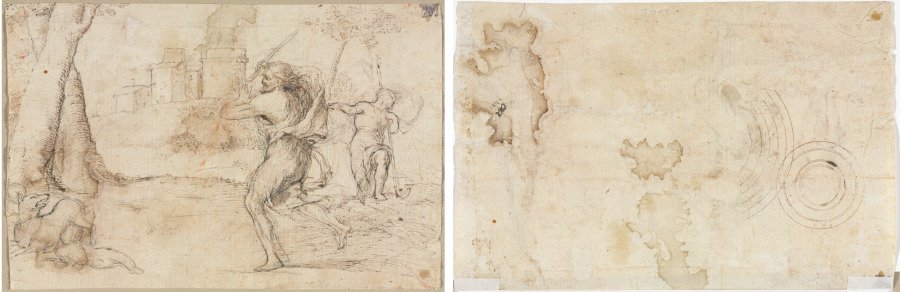
Romanino (c. 1484-1566), born Girolamo Romani, was a Brescian painter known for the expressive, naturalistic manner that makes him one of the most important painters of the High Renaissance in Brescia. Romulus and Remus Found by Faustulus from c. 1535 depicts the legendary episode in which the shepherd Faustulus discovers the twin founders of Rome in the expressive, naturalistic manner that distinguishes Romanino's best history paintings from the more classical manner of his Venetian contemporaries. The c. 1535 date places this in Romanino's mature period, when he was producing the expressive history paintings that are his most accomplished works.
Cultural Impact
Romulus and Remus Found by Faustulus is important in the history of Brescian painting because it demonstrates the expressive, naturalistic manner that Romanino brought to history subjects as the most important painter of the High Renaissance in Brescia. Romanino's history paintings—combining expressive naturalism with compositional grandeur—represent an important alternative to the more classical tradition of Venetian painting, and the Romulus and Remus subject shows this alternative at its most accomplished.
Why It Matters
Romulus and Remus Found by Faustulus is Romanino's expressive Brescian manner: the legendary founding of Rome rendered in the naturalistic, expressive style that distinguishes the most important painter of the High Renaissance in Brescia. The c. 1535 painting shows an alternative to the Venetian classical tradition.