Description
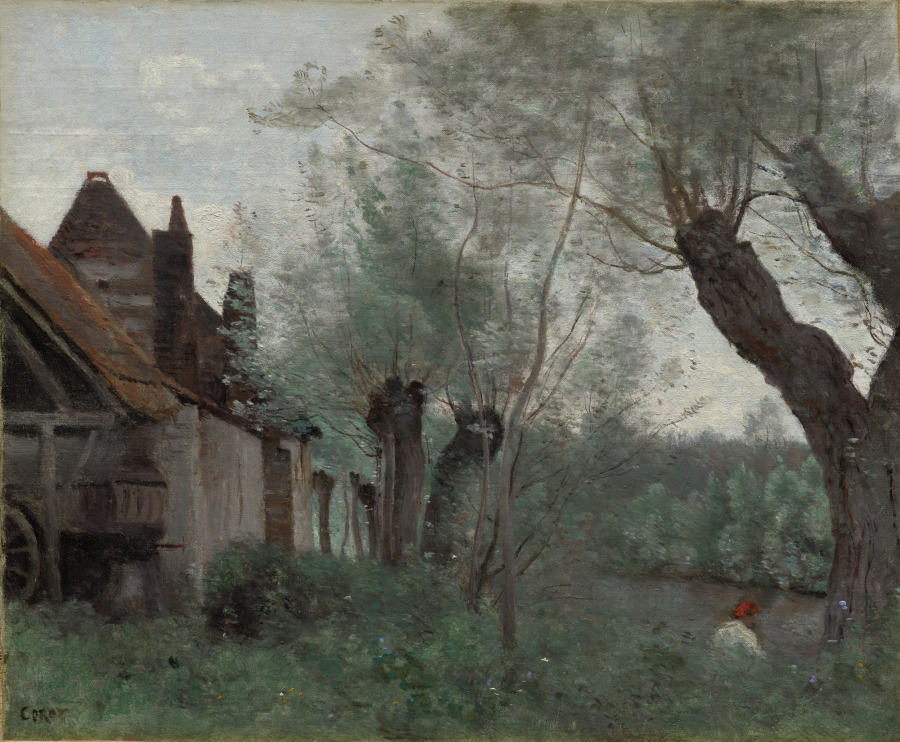
Corot based his large oil painting on drawings and oil sketches made outdoors. Attracted to the beauty of the Italian countryside, he often sketched around Rome, where he lived from 1825 to 1828. This painting's highly structured composition, based on forms moving into the distance along a series of diagonals, is characteristic of Corot's early style and recalls the classical landscapes of 17th-century painter Nicholas Poussin.
Provenance
Clément Jourdan [1836-1908], Paris, France, 1889. (1889); Seganville family, Château St. Pierre-de-Groupiac, France; (Probably Harry Sperling, New York.); Paul Rosenberg & Co., Paris and New York, by 1960. (1960-1963); Paul Rosenberg & Co., Paris, France and New York, NY, sold to the Cleveland Museum of Art (1963); The Cleveland Museum of Art, Cleveland, OH (1963)
Accession Number
1963.91
Medium
oil on fabric
Dimensions
Framed: 130 x 167.5 x 9.5 cm (51 3/16 x 65 15/16 x 3 3/4 in.); Unframed: 97.6 x 135.8 cm (38 7/16 x 53 7/16 in.)
Classification
Painting
Credit Line
Leonard C. Hanna Jr. Fund
Tags
Painting Neoclassical & Romantic (1751–1850) Oil Painting French Color: Blue Color: Brown
Background & Context
Background Story
La Cervara, the Roman Campagna is an early work by Corot, painted during his first trip to Italy (1825-1828) or shortly after. The Roman Campagna—the flat, sparsely populated countryside surrounding Rome—was the landscape that every French painter of Corot's generation was expected to study, and Corot's view of La Cervara demonstrates the influence of the Neoclassical tradition that governed French landscape painting in the 1820s. The composition is organized according to academic principles of balance and variety, with carefully arranged tree groups, graded planes of recession, and a golden light that idealizes the Roman countryside.
Cultural Impact
Corot's early Italian landscapes are among the most important documents in the history of French landscape painting because they show the Neoclassical tradition at its most accomplished, just before it was challenged by the Barbizon painters and the Impressionists. La Cervara demonstrates the principles of historical landscape painting (paysage historique) that Corot learned from his teachers: balanced composition, ideal light, and the integration of architecture and nature according to classical principles.
Why It Matters
La Cervara, the Roman Campagna is young Corot learning the Neoclassical tradition: the Roman Campagna composed according to academic principles of balance, variety, and ideal light. The painting shows the tradition that Corot would later transform—from this Neoclassical beginning, he would develop the silvery tonal landscapes that bridged Neoclassicism and Impressionism.