Description
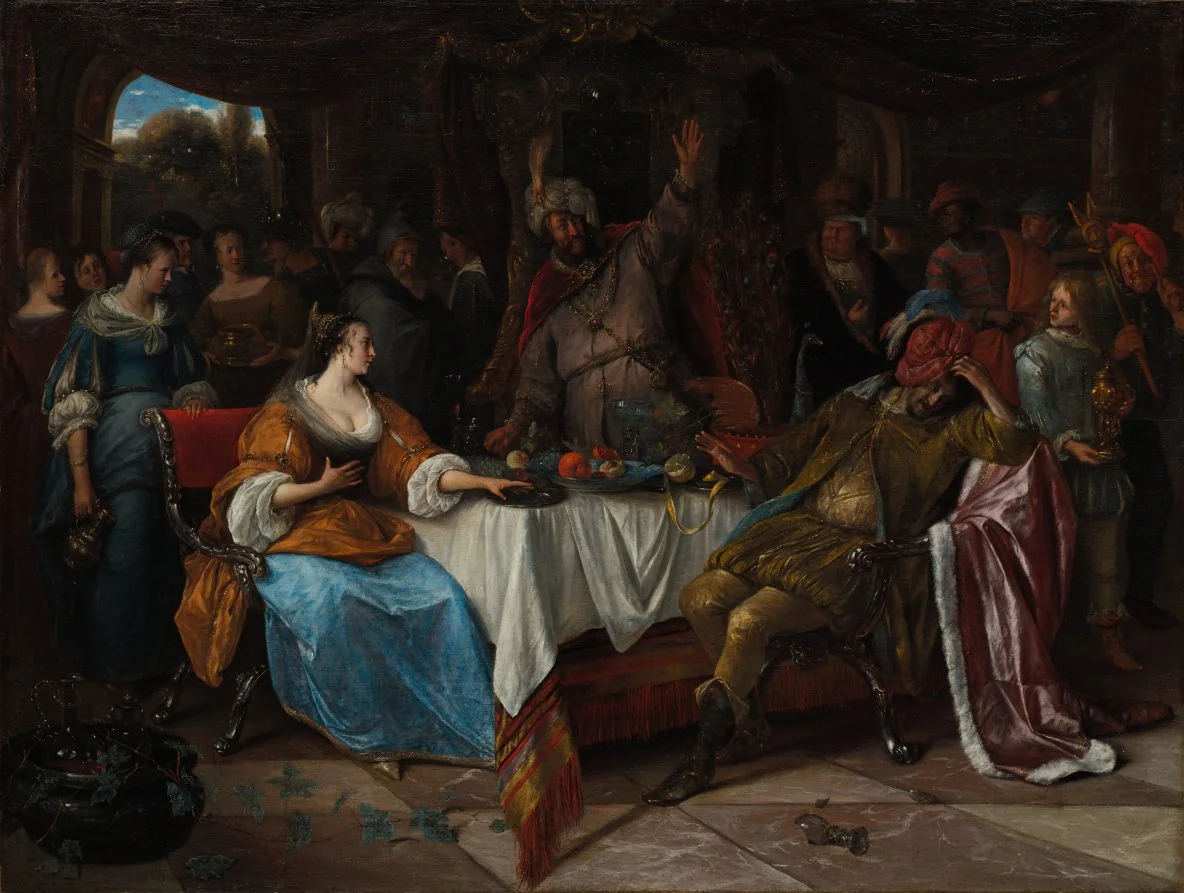
Esther, the wife of the Persian king Ahasuerus, effectively concealed her Jewish identity until the prime minister Haman hatched a plot to annihilate the kingdom’s Jews. To save her people Esther persuades the king (at the center) to rescind his order. He then turns against Haman, who slumps in his seat, aware of his sudden fall from power and his bleak future.
Provenance
[]
Accession Number
1964.153
Medium
oil on canvas
Dimensions
Framed: 96.5 x 119.5 x 11 cm (38 x 47 1/16 x 4 5/16 in.); Unframed: 70 x 93 cm (27 9/16 x 36 5/8 in.)
Classification
Painting
Credit Line
John L. Severance Fund
Tags
Painting Baroque (1600–1750) Oil Painting Canvas Dutch Color: Orange
Background & Context
Background Story
Esther, Ahasuerus, and Haman from around 1668 is one of Steen's most ambitious history paintings, depicting the dramatic moment from the Book of Esther when Queen Esther reveals the plot of the villain Haman to King Ahasuerus. Steen's treatment of this biblical subject is characteristically dramatic: the figures are arranged in a theatrical composition that draws on the conventions of both history painting and genre painting, with Esther's revelation, Ahasuerus's surprise, and Haman's terror all rendered with the expressive directness that distinguishes Steen's approach to every subject.
Cultural Impact
Steen's biblical paintings are important because they demonstrate that his comic genre paintings were not the limit of his ability but a choice—a preference for depicting the comic side of human nature rather than an inability to handle serious subjects. Esther, Ahasuerus, and Haman shows Steen applying the same dramatic directness and expressive intensity to a biblical subject that he brought to his domestic scenes, proving that the 'Jan Steen household' was the work of an artist who could also paint like a history painter when the subject demanded it.
Why It Matters
Esther, Ahasuerus, and Haman is Jan Steen as a history painter: the biblical drama of Esther's revelation rendered with the same expressive directness and theatrical composition that distinguish his genre paintings. The painting proves that Steen's comic domestic scenes were a choice, not a limitation—the same artist who painted chaotic households could also paint biblical drama when the subject called for it.
![Saint Bernard and Saint Catherine of Alexandria with the Virgin of the Annunciation [right panel]](https://api.nga.gov/iiif/e6890364-4d99-4684-a62b-5060ee3c3446/full/400,/0/default.jpg)