Description
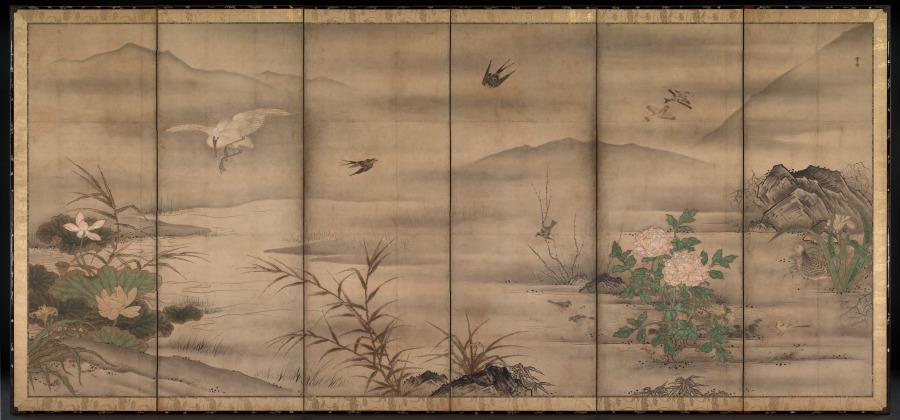
This is one of two paintings possibly by Sesshū Tōyō. They once flanked a central scroll with an ink landscape. The unbalanced nature of the compositions, however, suggests they may be images recycled from larger paintings. The one with sweet osmanthus and hibiscus is an autumn scene, the other is a summer scene with daylilies and gardenias. Folding screens often contrast two seasons or depict all four across a single pair of screens. Sesshū’s works were sufficiently prized that repurposing them in fragmentary form to display in an alcove of a luxurious room would not be an unusual choice.
Provenance
Mrs. A. Dean Perry [Helen Wade Greene Perry] [1911-1996], Cleveland, OH, bequest to the Cleveland Museum of Art (?-1964); The Cleveland Museum of Art, Cleveland, OH (1964-)
Accession Number
1964.157.2
Medium
Hanging scroll from a triptych; ink and color on silk
Dimensions
Image: 55.9 x 53.4 cm (22 x 21 in.); Overall: 117 x 58 cm (46 1/16 x 22 13/16 in.)
Classification
Painting
Credit Line
Gift of Mrs. A. Dean Perry
Tags
Painting Renaissance (1400–1599) Ink Silk Painting Japanese Color: Gold
Background & Context
Background Story
Sesshu Toyo (1420-1506) was a Japanese painter known as one of the most important painters of the Muromachi period, whose ink landscapes and bird-and-flower paintings make him one of the most important Japanese painters in history. Birds and Flowers from the mid-1400s to early 1500s depicts birds and flowers in the ink manner that distinguishes Sesshu's best work from the more decorative painting of his contemporaries. Sesshu traveled to China and studied Chinese ink painting, and his return to Japan brought a new level of accomplishment to Japanese ink painting that would influence all subsequent Japanese painting.
Cultural Impact
Birds and Flowers is important in the history of Japanese painting because it demonstrates the ink manner that Sesshu brought to bird-and-flower painting as one of the most important Japanese painters in history. Sesshu's ink paintings—combining the Chinese ink tradition with Japanese artistic sensibility—represent one of the most important developments in Japanese painting, and the mid-1400s to early 1500s painting shows this development at the level of accomplishment that would influence all subsequent Japanese painting.
Why It Matters
Birds and Flowers is Sesshu's Muromachi ink painting: birds and flowers rendered in the ink manner of one of the most important Japanese painters in history. The mid-1400s to early 1500s painting shows the combination of Chinese ink tradition with Japanese artistic sensibility that would influence all subsequent Japanese painting.