Description
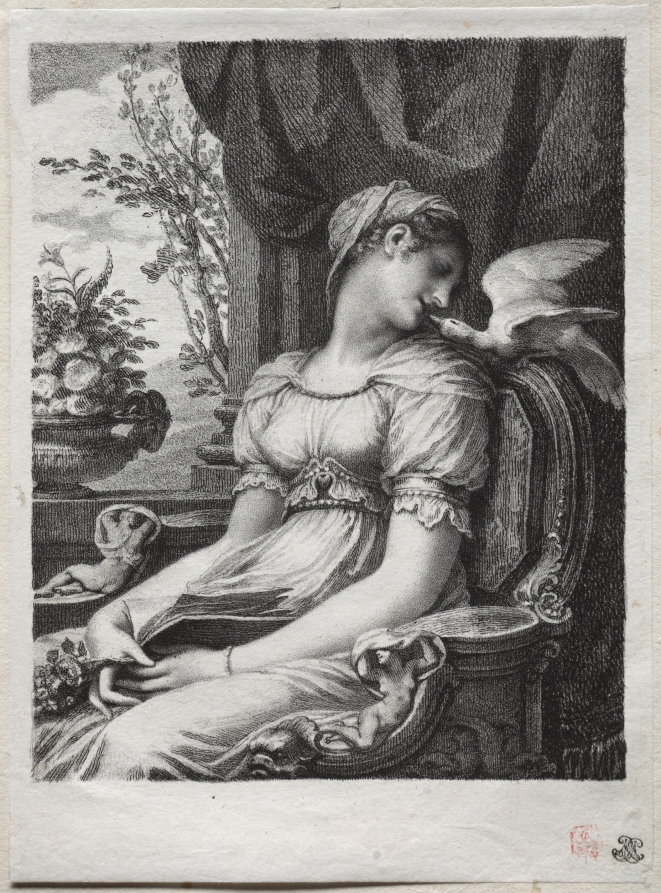
The artist made this sketch in preparation for a full-length portrait of Madame Dufresne that is now lost. Prud'hon showed the sitter—probably the wife of an art dealer—in a landscape where she is seated in a relaxed pose with her legs crossed. According to an early auction record, the composition is based upon one of several sketches Prud'hon made for a portrait of Empress Josephine (1763–1814). The empress probably rejected the pose as too casual. Prud'hon's portraits show his skill in capturing emotions, especially melancholy. This is true of the Cleveland portrait; despite its rough surface, we sense the sitter's gentle demeanor and slightly wistful expression. In 1789 Prud'hon was awarded the Prix de Rome, a scholarship that allowed especially gifted French art students the chance to study in Rome. While in Italy, Prud'hon was deeply influenced not only by ancient Roman art but also by the lively, international Neoclassical movement that was centered there. After his return to France, the artist became very popular with Napoleon, painting portraits of the emperor and his entourage and acting as Empress Josephine's drawing instructor.
Provenance
Studio of the artist (c. 1816 - 1823); Charles Boulanger de Boisfremont [1773-1838], probably bequeathed to his daughter, Henri Power (Probably 1823 - 1838); Probably Henri Power [d. 1864], probably to Charles Boulanger de Boisfremont fils (Probably 1838 - 1864); Probably Charles Boulanger de Boisfremont fils (Probably 1864 - 1870); (Boisfremont fils sale, Hôtel Drouot, Paris, April 9, 1870, no. 8, sold to Monsieur de Norzy) (1870); Monsieur de Norzy (1870 - by 1874); M. Jeanne-Deslandes (By 1874); (Sale, Hôtel Drouot, Paris, April 24, 1886, no. 52) (1886); Collection Henri Rochefort [1831-1913], Paris (By 1887); Paul-Arthur Chéramy [1840-1912], Paris (Until 1908); (Chéramy sale, Galerie Georges Petit, Paris, May 5-7, 1908, no. 95, bought in) (1908); Probably Paul-Arthur Chéramy [1840-1912], Paris (1908-1912); (Chéramy estate sale, Hôtel Drouot, Paris, April 14-16, 1913, no. 391, sold to Jacob) (1913); Jacob (1913-); David David-Weill [1871-1952], Paris (By 1922 - at least 1937); Irwin Laughlin [1871-1941], Washington, D.C. (Probably until 1941); (Laughlin sale, Sotheby's, London, June 10, 1959, lot 123, possibly sold to Betts on behalf of Clifford Duits) (1959); Severance A. [1895-1989] and Greta Millikin [1903-1989], Cleveland, OH, given to the Cleveland Museum of Art (1963-1964); The Cleveland Museum of Art, Cleveland, OH (1964-)
Accession Number
1964.292
Medium
oil on paper mounted on fabric
Dimensions
Framed: 34.5 x 27 x 5 cm (13 9/16 x 10 5/8 x 1 15/16 in.); Unframed: 23.8 x 17.5 cm (9 3/8 x 6 7/8 in.)
Classification
Painting
Credit Line
Severance and Greta Millikin Collection
Tags
Painting Neoclassical & Romantic (1751–1850) Oil Painting French Color: Black
Background & Context
Background Story
Pierre-Paul Prud'hon (1758-1823) was a French painter known for the soft, sfumato manner that makes him the most important painter of the French transition from Neoclassicism to Romanticism. Mme. Dufresne from c. 1816 depicts the sitter in the soft, sfumato manner that distinguishes Prud'hon's best portraits from the more severe Neoclassical portraiture of his contemporaries. The c. 1816 date places this in Prud'hon's mature period, when he was producing the soft, sfumato portraits and allegorical paintings that made him the most important painter of the French transition from Neoclassicism to Romanticism.
Cultural Impact
Mme. Dufresne is important in the history of French portraiture because it demonstrates the soft, sfumato manner that Prud'hon brought to portraiture as an alternative to the severe Neoclassical manner of David and his followers. Prud'hon's soft portraits—combining the sfumato of Leonardo with the elegance of the French portrait tradition—represent the most important alternative to Neoclassical portraiture in French painting, and his influence on the development of Romantic portraiture was profound.
Why It Matters
Mme. Dufresne is Prud'hon's soft alternative to Neoclassicism: the sitter rendered in the sfumato manner that distinguishes the most important painter of the French transition from Neoclassicism to Romanticism. The c. 1816 portrait shows Prud'hon's combination of Leonardo's sfumato with French portrait elegance as an alternative to David's severe Neoclassicism.