Description
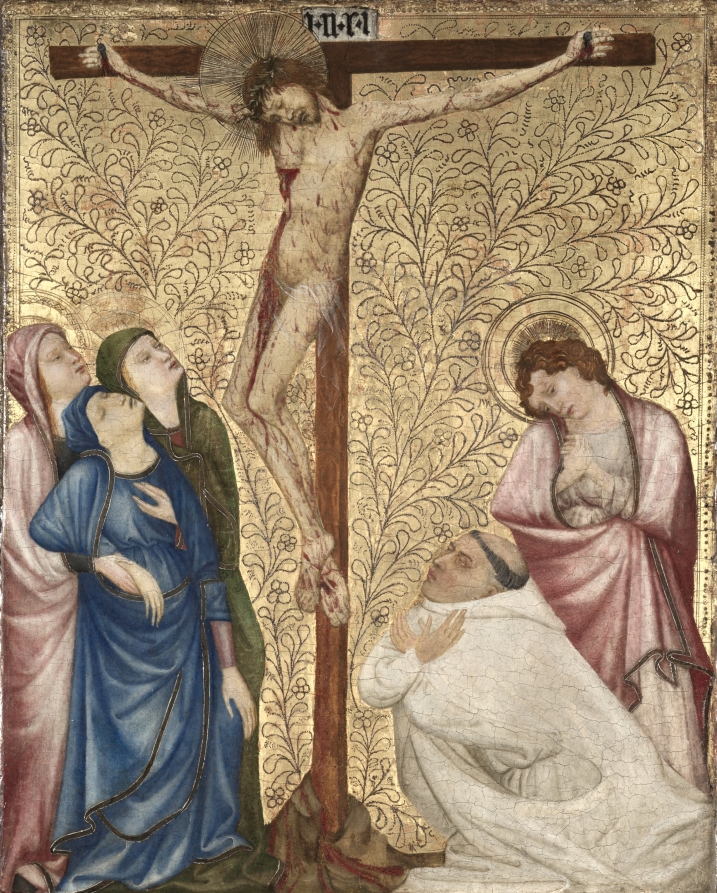
Jean de Beaumetz became the official court painter to the Burgundian duke, Philip the Bold, in 1376. Between 1389 and 1395 he created devotional paintings for the monks’ cells at the Chartreuse de Champmol, the monastery founded by Philip and his wife Margaret to house the ducal tombs. This panel, originally one of 26, is only one of two that have survived; the second is preserved in the Louvre in Paris. The Carthusians were intensely devoted to the Passion of Christ; particularly bloody images of the Crucifixion often decorated their cells. Isolated from one another, the monks contemplated the sacrifice of Christ (emphasized here by the presence of a Carthusian monk at the foot of the cross) creating an empathetic connection with the suffering of the Virgin who faints in the arms of the two Marys. Saint John the Evangelist, on the right, bows his head in sorrow. The punched decoration in the gold background represents the Trees of Life and Knowledge, emphasizing the biblical connection between Adam and Christ.
Provenance
Private collection, France; Wildenstein & Co., New York, NY, sold to the Cleveland Museum of Art (-1964); The Cleveland Museum of Art, Cleveland, OH (1964-)
Accession Number
1964.454
Medium
oil on oak panel
Dimensions
Framed: 63.5 x 52.5 x 6.7 cm (25 x 20 11/16 x 2 5/8 in.); Unframed: 56.6 x 45.7 cm (22 5/16 x 18 in.)
Classification
Painting
Credit Line
Leonard C. Hanna Jr. Fund
![Saint Bernard and Saint Catherine of Alexandria with the Virgin of the Annunciation [right panel]](https://api.nga.gov/iiif/e6890364-4d99-4684-a62b-5060ee3c3446/full/400,/0/default.jpg)