Description
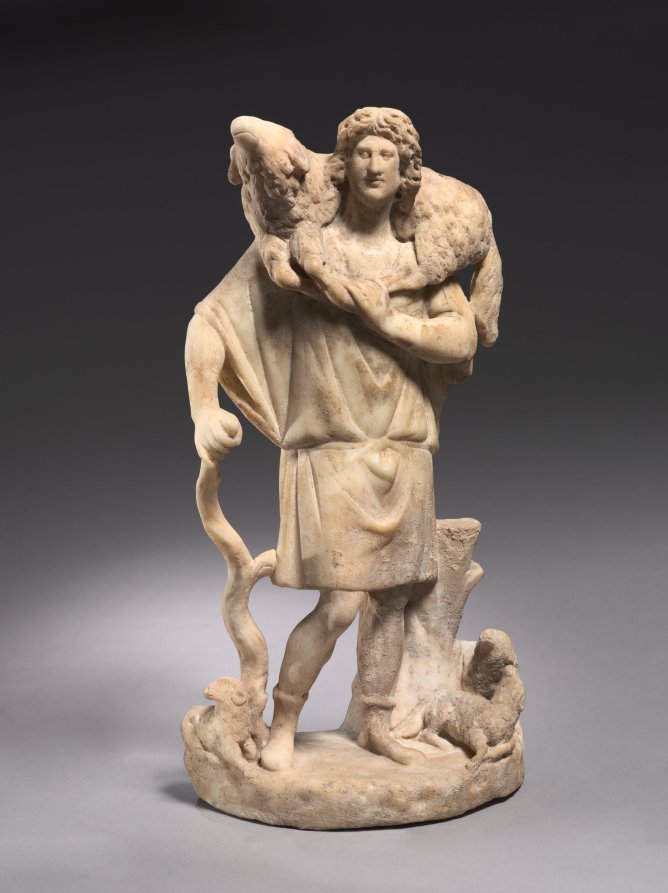
Images of a youthful shepherd standing among his flock and carrying a sheep over his shoulders were popular with Romans of traditional faith as well as Christians living in the Late Roman Empire. Painted on the walls or the ceiling of a burial chamber or carved on a marble sarcophagus, this image might simply invoke the deceased’s hope for a peaceful afterlife spent in a pastoral setting. For Christians, this traditional Roman image took on a more specific meaning. It could be understood to refer to the passage in the Gospel according to John in which Christ said of himself: "I am the good shepherd. The good shepherd lays down his life for the sheep." (John 10:11). Allegedly found together with the Jonah statuettes, it is indeed likely that this figure represents Christ as the Good Shepherd.
Provenance
According to William Wixom, an unconfirmed report tells us that the entire group (1965.237-1965.247) was found in a single, huge pithos or jar.; (J. J. Klejman, New York) (-1965); The Cleveland Museum of Art, Cleveland, OH (1965-)
Accession Number
1965.241
Medium
marble
Dimensions
Overall: 49.5 x 26 x 16.2 cm (19 1/2 x 10 1/4 x 6 3/8 in.)
Classification
Sculpture
Credit Line
John L. Severance Fund