Description
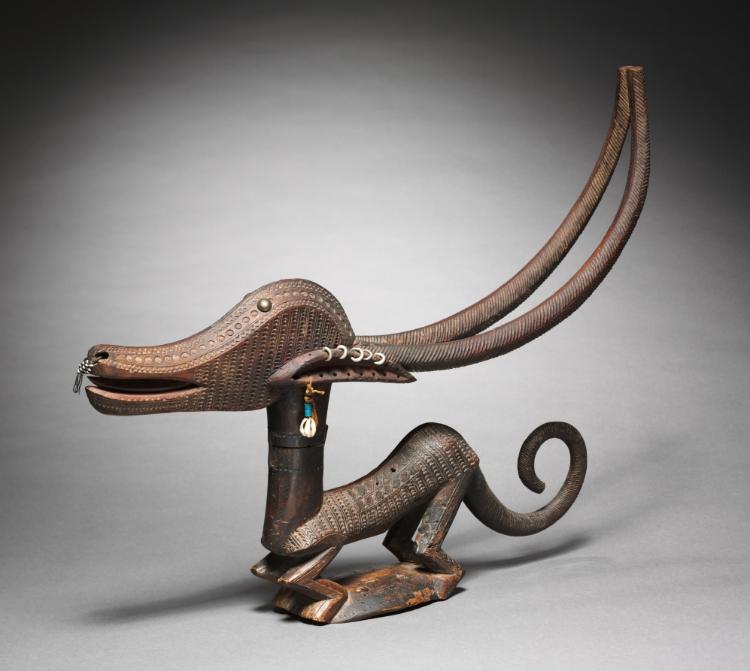
Chi wara—a mythical “farming beast”—was said to teach farming to the Bamana people. Carved patterns cover this female chi wara’s body, highlighting its muscles and emphasizing that it is no earthly animal, but rather an agricultural spirit that combines human, antelope, and anteater elements. This example wears earrings and a nose ring of imported metals and beads. Its carver—a blacksmith—used a naturalistic style common south of the city of Bamako. Accompanied by women’s songs, male performers danced paired male-and-female chi wara headdresses affixed to basketry caps at agricultural competitions and weddings.
Provenance
(J.J. Klejman Gallery, New York, NY) (1954); Mrs. Ralph M. Coe [Dorothy deWolf Tracey, 1890-1966] Cleveland, OH, given to the Cleveland Museum of Art, Cleveland, OH (1954-1965); The Cleveland Museum of Art, Cleveland, OH (1965-)
Accession Number
1965.325
Medium
Wood, cowrie shells, glass beads, possibly aluminum, iron alloy, upholstery studs, and natural fibers
Dimensions
Overall: 44.5 x 66 cm (17 1/2 x 26 in.)
Classification
Mask
Credit Line
Gift of Mrs. Ralph M. Coe in memory of Ralph M. Coe