Description
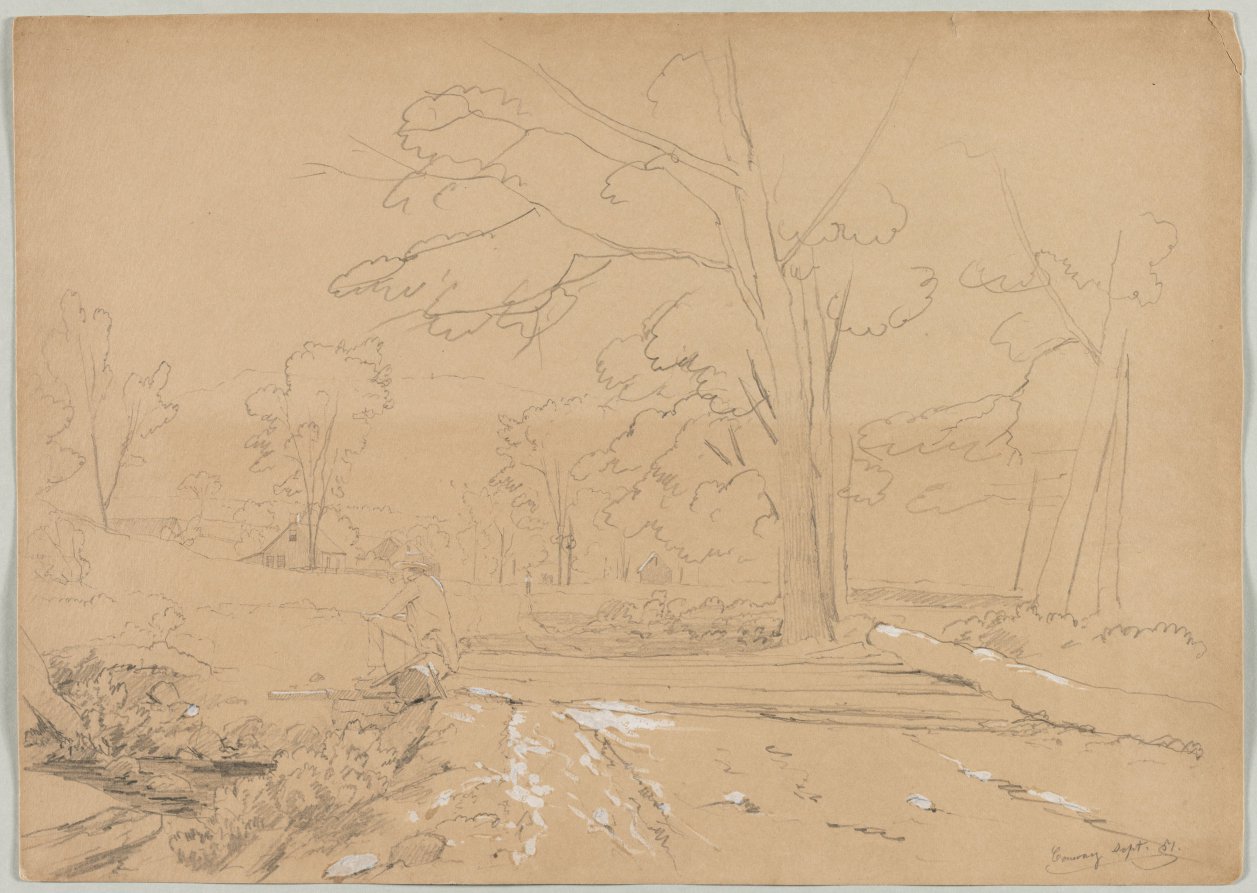
Johnson’s devotion to carefully observing nature is evident in his detailed rendering of a riverbed. Located in a village that provided a popular jumping-off point for tourists visiting the White Mountains, this untamed site features a haphazard arrangement of angled boulders, slippery moss, splintered tree branches, and dense undergrowth. Contemporary travel guidebooks often cautioned against the physical challenges—and the potential for injury—encountered by venturing into such inner recesses of the woods; one warned that “wild forest-clambering” could be akin to “fighting a phalanx of porcupines.”
Provenance
(R. Schoelkopf Gallery, New York)
Accession Number
1967.125
Medium
oil on canvas
Dimensions
Framed: 63.8 x 74.3 x 7 cm (25 1/8 x 29 1/4 x 2 3/4 in.); Unframed: 43.2 x 53.3 cm (17 x 21 in.); Former: 52 x 62 x 8 cm (20 1/2 x 24 7/16 x 3 1/8 in.)
Classification
Painting
Credit Line
Mr. and Mrs. William H. Marlatt Fund
Tags
Painting Impressionist & Modern (1851–1900) Oil Painting Canvas American Color: Orange
Background & Context
Background Story
David Johnson (1827-1908) was an American painter known for the precisely observed landscape paintings of the Hudson River School that make him one of the most accomplished painters of the second generation of the Hudson River School. Study, North Conway, New Hampshire from 1851 depicts the New Hampshire landscape in the precisely observed manner that distinguishes Johnson's best work from the more grandiose landscape painting of his Hudson River School contemporaries. The 1851 date places this in Johnson's most productive period, when he was producing the precisely observed landscape paintings that are his most accomplished works, and the North Conway subject shows his talent for depicting the New England landscape with both precision and atmosphere.
Cultural Impact
Study, North Conway, New Hampshire is important in the history of the Hudson River School because it demonstrates the precisely observed manner that Johnson brought to landscape as one of the most accomplished painters of the second generation. Johnson's precisely observed landscapes—emphasizing precise observation over the grandiose manner of the first generation of the Hudson River School—represent an important development in American landscape painting, and the 1851 painting shows this development at its most precisely observed.
Why It Matters
Study, North Conway, New Hampshire is Johnson's precisely observed Hudson River School: the New Hampshire landscape rendered in the precise manner of one of the most accomplished painters of the second generation. The 1851 painting shows the emphasis on precise observation over grandiose manner that distinguishes the second generation from the first generation of the Hudson River School.