Description
Yun Shouping came from Piling (modern Changzhou), Jiangsu province, a center of floral, plant, and insect painting. He had joined the anti-Manchu resistance, was briefly imprisoned, and witnessed the death of family members in 1644.
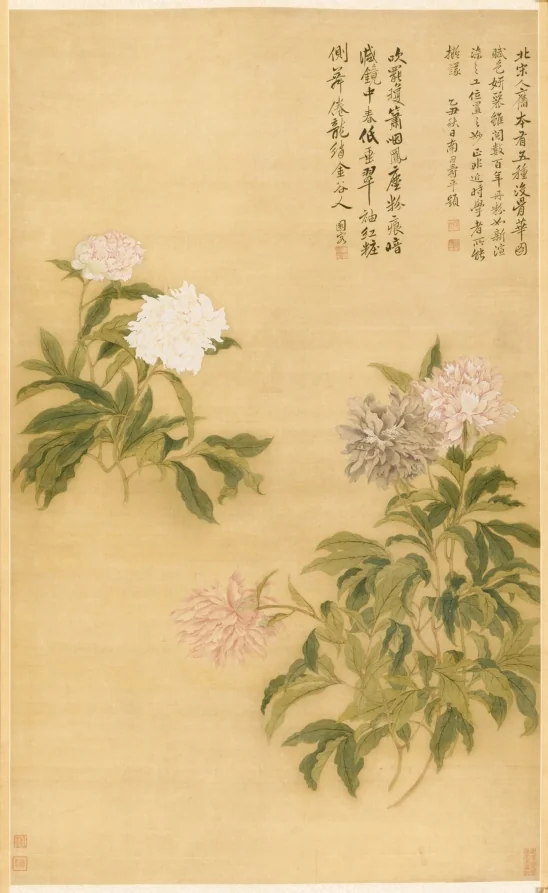
Like other artists, Yun Shouping expressed his Ming loyalism in coded pictures. The peony, king of flowers, and a spring garden motif developed new meaning during the Qing dynasty. The inscription indicates that Yun turns the flower into a motif representing the glorious past. The herbaceous peonies here appear somewhat withered and pale, with faint reddish veins running through its broken branches, perhaps a coded message.
The inscription reads,
An old painting by an anonymous painter of the Northern Song Dynasty has five varieties of flowers painted in the boneless manner. Its colors are so beguiling and beautiful, that even after several hundred years its lead pigments are like new. The skill with which the ink and colors were applied and the subtlety of its composition find no equal among modern followers.
Like other artists, Yun Shouping expressed his Ming loyalism in coded pictures. The peony, king of flowers, and a spring garden motif developed new meaning during the Qing dynasty. The inscription indicates that Yun turns the flower into a motif representing the glorious past. The herbaceous peonies here appear somewhat withered and pale, with faint reddish veins running through its broken branches, perhaps a coded message.
The inscription reads,
An old painting by an anonymous painter of the Northern Song Dynasty has five varieties of flowers painted in the boneless manner. Its colors are so beguiling and beautiful, that even after several hundred years its lead pigments are like new. The skill with which the ink and colors were applied and the subtlety of its composition find no equal among modern followers.
Provenance
C. C. Wang 王季遷 [1907–2003], New York, NY, sold to the Cleveland Museum of Art (?–1967); The Cleveland Museum of Art, Cleveland, OH (1967–)
Accession Number
1967.192
Medium
Hanging scroll; ink and color on silk
Dimensions
Painting: 118.7 x 71.8 cm (46 3/4 x 28 1/4 in.); Overall with knobs: 226 x 84.4 cm (89 x 33 1/4 in.)
Classification
Painting
Credit Line
Gift of the American Foundation for the Maud E. and Warren H. Corning Botanical Collection
Tags
Painting Baroque (1600–1750) Ink Silk Painting Chinese Color: Orange Color: White
Background & Context
Background Story
Yun Shouping (1633-1690) was a Chinese painter known as one of the Six Masters of the Qing dynasty, whose flower paintings in the boneless (moogu) manner—with outlines suggested by color washes rather than drawn ink lines—represent one of the most accomplished traditions in Chinese painting. Herbaceous Peony from 1685 depicts a peony in the boneless manner that Yun Shouping developed from his study of earlier flower painters, creating a type of painting that combines the delicacy of the flower tradition with the expressive freedom of the boneless technique. The 1685 date places this in Yun Shouping's mature period, when he was producing the flower paintings in the boneless manner that are his most accomplished works.
Cultural Impact
Herbaceous Peony is important in the history of Chinese painting because it demonstrates the boneless manner that Yun Shouping developed as one of the Six Masters of the Qing dynasty. Yun Shouping's transformation of flower painting—from the more formal, outlined manner of earlier painters to the boneless manner that suggests form through color washes—represents one of the most important developments in the history of Chinese flower painting, and the 1685 painting shows this transformation at its most accomplished.
Why It Matters
Herbaceous Peony is Yun Shouping's boneless flower painting: a peony rendered in the moogu manner that suggests form through color washes rather than drawn ink lines. The 1685 painting shows one of the Six Masters of the Qing dynasty transforming the flower painting tradition from formal outlines to the expressive freedom of the boneless technique.