Description
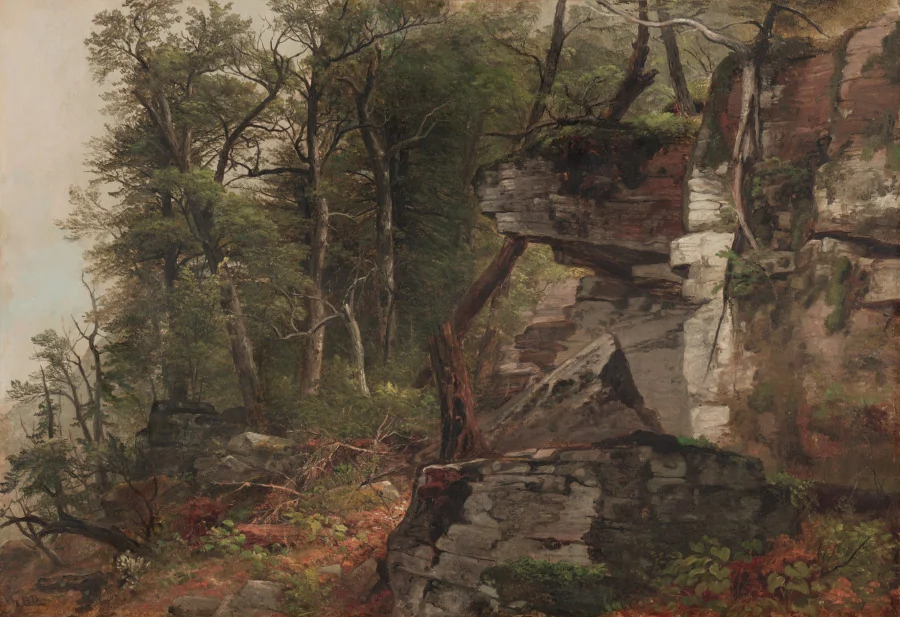
Durand was one of the first American artists to paint outdoors, rather than in the confines of a studio, which was the longstanding tradition. This outdoor oil sketch of a seemingly random corner of the woods offers an intimate view of a rock outcropping amid lush vegetation. Its small-scale, unusually cropped composition contrasts with the sweeping vistas in many other landscapes of the era.
Provenance
The Cleveland Museum of Art, Cleveland, OH (1968-); (Kennedy Galleries, New York, NY, sold to the Cleveland Museum of Art) (Until 1968); [Private collection, Philadelphia, probably consigned to Kennedy Galleries?] (c. 1966-1968); (Sotheby Parke Bernet, New York, NY, Nov. 17, 1966, lot 48) (1966); Private collection (-1966)
Accession Number
1968.21
Medium
oil on canvas
Dimensions
Framed: 64.8 x 83.2 x 7.9 cm (25 1/2 x 32 3/4 x 3 1/8 in.); Unframed: 42.5 x 61.3 cm (16 3/4 x 24 1/8 in.); Former: 53.5 x 72 x 6.5 cm (21 1/16 x 28 3/8 x 2 9/16 in.)
Classification
Painting
Credit Line
Mr. and Mrs. William H. Marlatt Fund
Tags
Painting Neoclassical & Romantic (1751–1850) Oil Painting Canvas American Color: Brown
Background & Context
Background Story
Trees on a Rocky Hillside from around 1849 is Durand's Hudson River School principle reduced to its essentials: trees and rocks, rendered with the precise observation that was his artistic creed. The hillside composition eliminates the distant vista that organizes most of Durand's woodland interiors, focusing the viewer's attention entirely on the foreground trees and the rocks that support them. The result is a painting that is simultaneously a botanical study (each tree species is precisely identified), a geological study (the rock formation is accurately rendered), and a landscape composition of considerable sophistication—the tree groupings and rock formations are arranged with the care that Durand brought to all his work.
Cultural Impact
Durand's rock and tree studies are among his most influential works because they demonstrate the 'nature first' principle that he advocated throughout his career. Rather than arranging trees and rocks into a pleasing but conventional composition, Durand studied the specific growth patterns of real trees and the specific geological formations of real rocks, producing landscapes that were faithful to nature even when they were composed in the studio. Trees on a Rocky Hillside is a model of this approach.
Why It Matters
Trees on a Rocky Hillside is Durand's 'nature first' principle in action: specific tree species, specific rock formations, and the precise observation that was his artistic creed. The painting proves that faithful observation can produce compositions as sophisticated as any studio convention—nature itself is the best designer.