Description
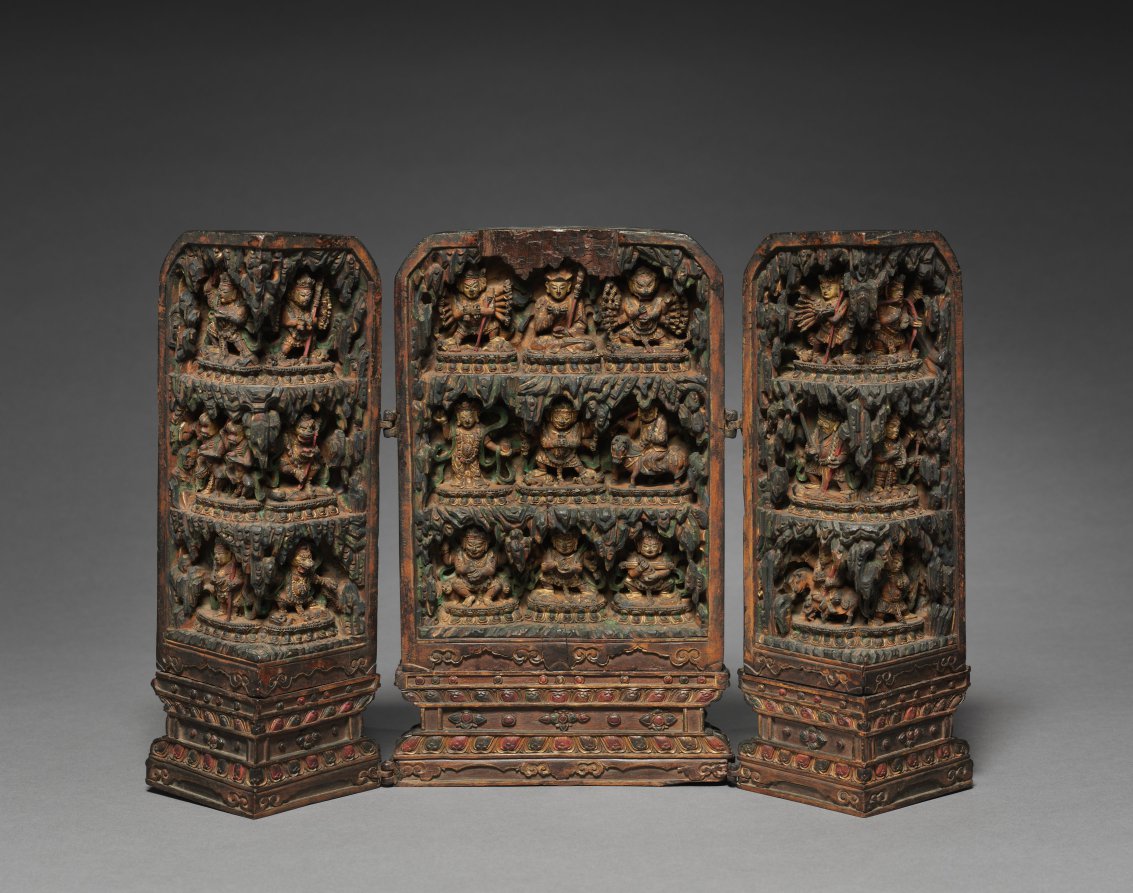
Carved from a solid section of a log, the shrine contains images of protectors of tantric Buddhism—a branch that developed in northern India and became prominent in the Himalayas by the 700s. The central figure in the top row is Padmasambhava (Indian, active in Tibet in the 740s), venerated as the founder of one of the four main Tibetan monastic orders. Incised on the exterior are images of protectors, mantras written in Tibetan script, and a sacred funerary monument called a stupa. Tantric practice emphasizes recitation of mantras that invoke the powers of compassion, wisdom, and protection.
Provenance
(Hôtel Drouot, Paris, France, Collection G... Œuvres d'art et de haute curiosité du Tibet sale, lot no. 791) (November 21–24, 1904); (Eduard Lingero, Belgium, sold to Claude De Marteau) (1940s?–1961); (Claude De Marteau [d. 2017], Brussels, Belgium, sold to the Cleveland Museum of Art) (1961–1968); The Cleveland Museum of Art, Cleveland, OH (1968–)
Accession Number
1968.214
Medium
wood with mineral pigments and metal
Dimensions
Diameter: 16.2 cm (6 3/8 in.); Overall: 25.4 cm (10 in.)
Classification
Sculpture
Credit Line
Andrew R. and Martha Holden Jennings Fund