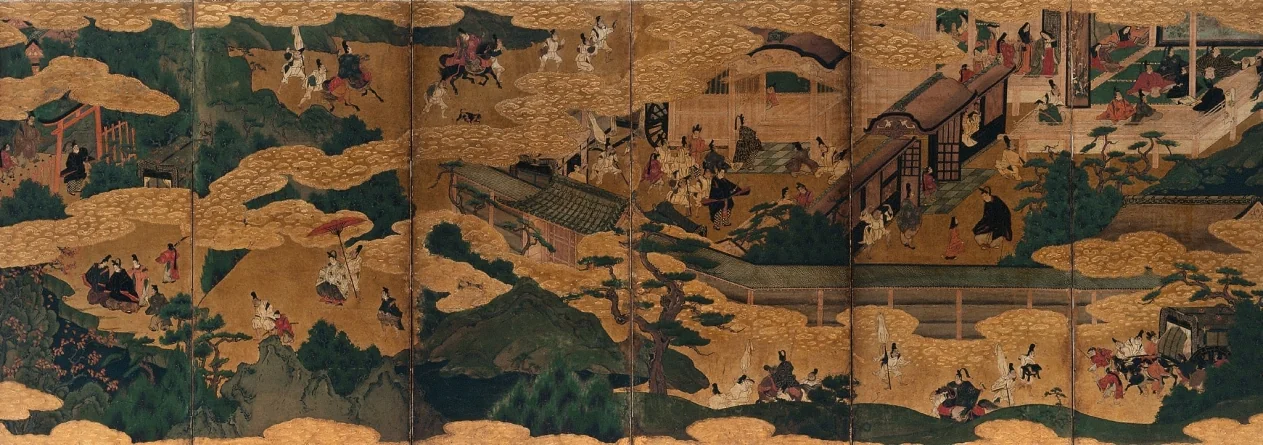
Description
While the 11th-century Tale of Genji is universally regarded as Japan's literary masterpiece, the source for visual imagery in Japanese culture is rivaled by another literary classic, the Tales of Ise. A 10th-century anthology of poems interspersed with commentary, the Ise portrays the emotional and geographical journey of a courtier from the capital (Kyoto) into the countryside and beyond. The poems describe features of the natural, untamed terrain, linking them to the rather melancholy state of the traveler.
Since the Tales of Ise was—and remains today—well read by educated Japanese, a person viewing these folding screens would immediately recognize its subject, organized as a series of discrete scenes read from right to left. Neither a signature nor a seal identifies the artist, but judging from related paintings, the work can be ascribed to an artist working in Kyoto during the first quarter of the 17th century in the manner of the painter Iwasa Matabei (1578–1650). This type of historical narrative composition became quite popular around 1600 among patrons favoring a distinctly Japanese style of painting which employed rich mineral pigments and a liberal use of gold.
Since the Tales of Ise was—and remains today—well read by educated Japanese, a person viewing these folding screens would immediately recognize its subject, organized as a series of discrete scenes read from right to left. Neither a signature nor a seal identifies the artist, but judging from related paintings, the work can be ascribed to an artist working in Kyoto during the first quarter of the 17th century in the manner of the painter Iwasa Matabei (1578–1650). This type of historical narrative composition became quite popular around 1600 among patrons favoring a distinctly Japanese style of painting which employed rich mineral pigments and a liberal use of gold.
Provenance
(Elm and Company, Osaka, Japan, sold to the Cleveland Museum of Art) (?-1969); The Cleveland Museum of Art, Cleveland, OH (1969-)
Accession Number
1969.127.1
Medium
One of a pair of six-panel folding screens; ink, color and gold on paper
Dimensions
Image: 95.2 x 267 cm (37 1/2 x 105 1/8 in.); Overall: 109.3 x 258.9 cm (43 1/16 x 101 15/16 in.); Closed: 109.3 x 48.5 x 11 cm (43 1/16 x 19 1/8 x 4 5/16 in.)
Classification
Painting
Credit Line
John L. Severance Fund
Tags
Painting Baroque (1600–1750) Ink Panel Painting Gold Leaf Paper Color: Orange
Background & Context
Background Story
Scenes from the Tales of Ise from the mid-1600s depicts scenes from the Tales of Ise—the famous Japanese literary work of the Heian period—in the elegantly composed manner of the Edo period painting tradition. The Tales of Ise is one of the most important works of Japanese literature, and paintings depicting scenes from it represent one of the most accomplished traditions in Japanese painting. The mid-1600s date places this in the early Edo period, when paintings of scenes from literary classics were being produced by some of the most accomplished painters of the Japanese tradition.
Cultural Impact
Scenes from the Tales of Ise is important in the history of Japanese painting because it demonstrates the tradition of depicting scenes from one of the most important works of Japanese literature. The Tales of Ise—written in the Heian period—is one of the most important works of Japanese literature, and paintings depicting scenes from it represent one of the most accomplished traditions in Japanese painting. The mid-1600s painting shows this tradition in the early Edo period.
Why It Matters
Scenes from the Tales of Ise is an anonymous Edo period painting: scenes from one of the most important works of Japanese literature rendered in the elegantly composed manner of the Japanese painting tradition. The mid-1600s painting shows the tradition of depicting literary classics that is one of the most accomplished traditions in Japanese painting.