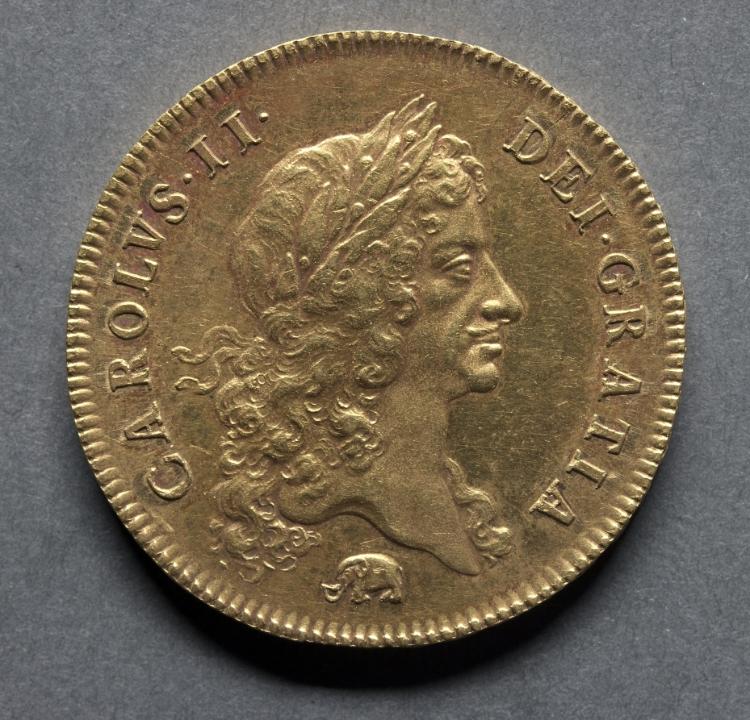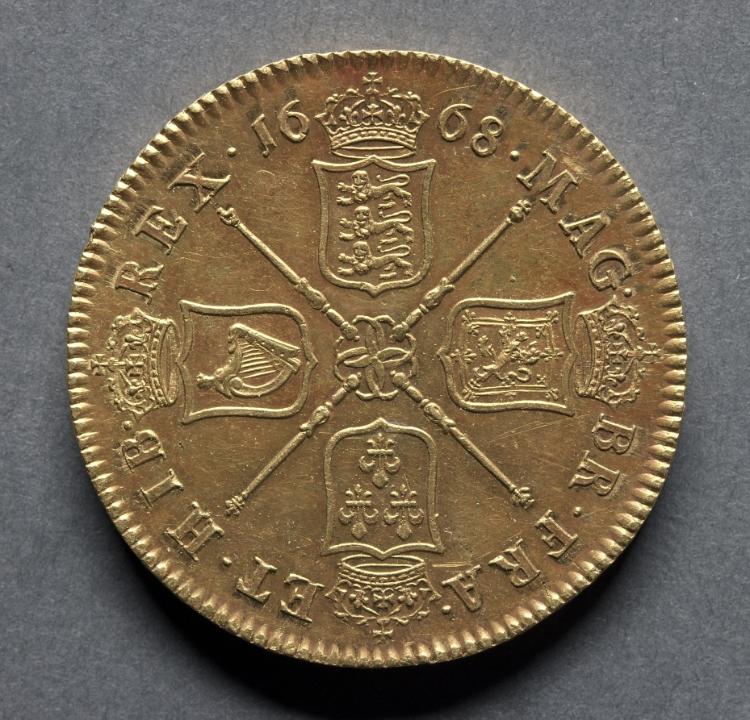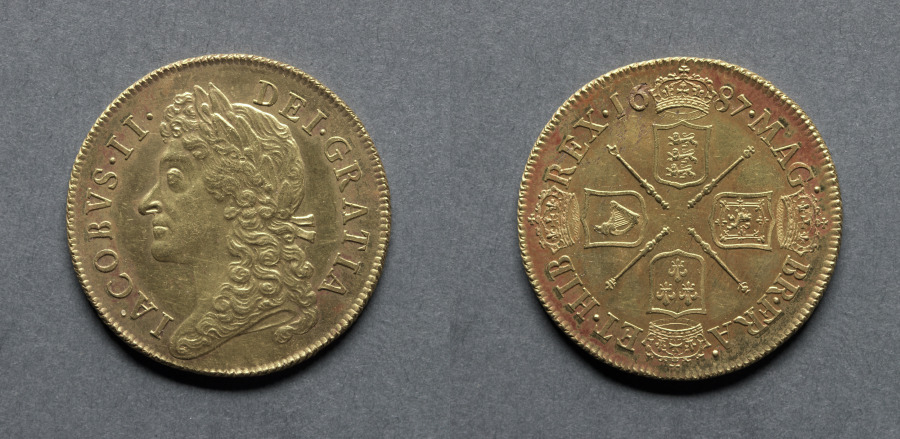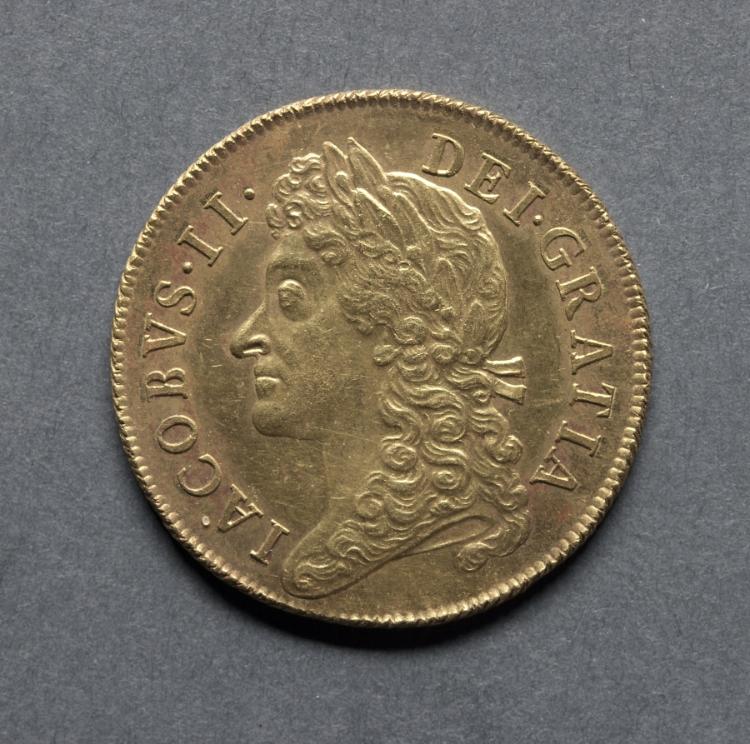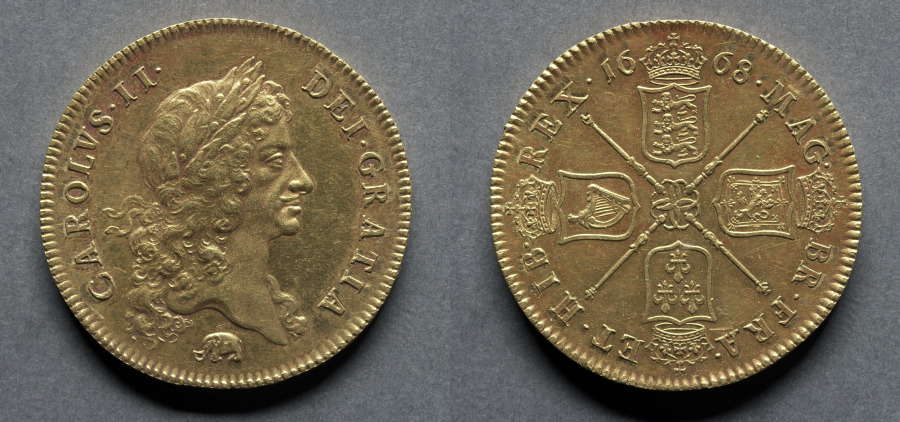
Description
Once the decision was made to reform the coinage of England, and hammered coinage abandoned, the whole range of money was simplified. The guinea was the unit (like the dollar), and multiples of two and five were struck.
One of the reasons for turning to mill coins was the long battle against the clipper (the act of shaving precious metal off coins for profit) and forger of coins. Not only were mill coins more exactly shaped, they were thick enough in larger denominations for a legend to be written on their edge as a protection against chipping. Here the edge legend translates: "An Ornament and a safeguard. In the—year of our reign."
The regnal year starts from the day the king ascends the throne. Thus the first regnal year of Charles II was calculated from the death of his father, Charles I, in 1649. The year 1668 was therefore the 19th (20th regnal) year of Charles I, whose regnal years ran from January 30 in one year to January 29 of the next.
One of the reasons for turning to mill coins was the long battle against the clipper (the act of shaving precious metal off coins for profit) and forger of coins. Not only were mill coins more exactly shaped, they were thick enough in larger denominations for a legend to be written on their edge as a protection against chipping. Here the edge legend translates: "An Ornament and a safeguard. In the—year of our reign."
The regnal year starts from the day the king ascends the throne. Thus the first regnal year of Charles II was calculated from the death of his father, Charles I, in 1649. The year 1668 was therefore the 19th (20th regnal) year of Charles I, whose regnal years ran from January 30 in one year to January 29 of the next.
Provenance
Mrs. Emery May Holden Norweb (1895-1984), Cleveland, OH, gifted to the Cleveland Museum of Art (-1969); The Cleveland Museum of Art, Cleveland, OH (1969-)
Accession Number
1969.199
Medium
gold
Dimensions
Diameter: 3.7 cm (1 7/16 in.)
Classification
Coins
Credit Line
The Norweb Collection