Description
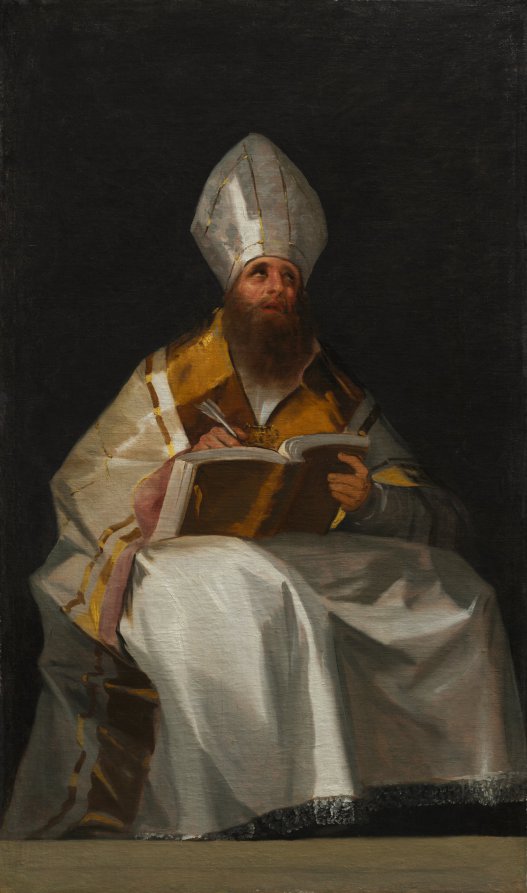
This work belongs to a series depicting Ambrose, Jerome, Augustine, and Gregory, key figures of early Catholicism. Saint Ambrose (about AD 340–391), the bishop of Milan, resolved important theological conflicts within the church and worked effectively with advocates of Roman paganism. The low viewpoint and large scale suggest that this painting hung high on the wall of a religious institution, but its original location remains unknown. In the late 1700s, Spain expelled all the Jesuits and sparked a transformation of the church. Many of these reformers turned back to early church history for inspiration, and this painting was probably commissioned by one of these new organizations.
Provenance
Marques de la Cueva del Rey, sold to Galerie Heinemann (Until 1928); (Galerie Heinemann, Munich, sold to Alessandro Contini-Bonacossi) (1928-1930); Alessandro Contini-Bonacossi (1878-1955), Florence, Italy, by descent to his heirs (1930-probably 1955); Family of Contini-Bonacossi, probably consigned to Pinakos, Inc. (Probably 1955-late 1950s); (Pinakos, Inc./Rudolf J. Heinemann, New York, NY, sold to the Cleveland Museum of Art) (Late 1950s-1969); The Cleveland Museum of Art, Cleveland, Ohio (1969-)
Accession Number
1969.23
Medium
oil on canvas
Dimensions
Framed: 148.7 x 225.3 x 10.3 cm (58 9/16 x 88 11/16 x 4 1/16 in.); Unframed: 190 x 113 cm (74 13/16 x 44 1/2 in.)
Classification
Painting
Credit Line
Leonard C. Hanna Jr. Fund