Description
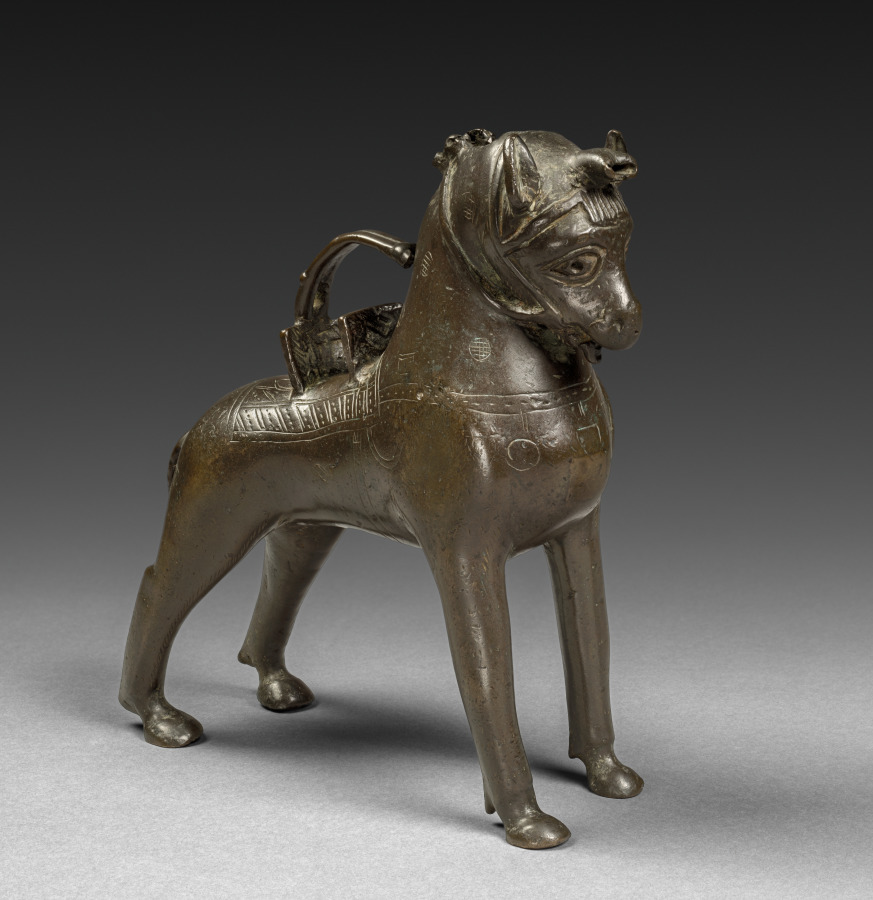
Aquamanilia, from the Latin aqua meaning water and manus meaning hands, were hollow cast vessels used for hand washing. Although originally intended for liturgical use they became a common sight in the homes of the nobility in the 1200s and 1300s. Often filled with scented water, these vessels were used to wash hands just before and after eating a meal. An accompanying catch basin would have caught the water as it was being poured. Here we see a proud and alert dappled gray warhorse, highly prized in the medieval period. The saddled but riderless form is rare; other popular aquamanilia include lions, dragons, griffins, and human heads.
Provenance
Castiglione, Vienna, purchased by Mrs. C. Porter Wilson; Mrs. C. Porter Wilson, New York, NY (?-1968); (Parke-Bernet, 25 October 1968, lot 112a) (1968); (Blumka Gallery, New York, NY, sold to the Cleveland Museum of Art) (1968-1969); The Cleveland Museum of Art, Cleveland, OH (1969-)
Accession Number
1969.26
Medium
copper alloy
Dimensions
Overall: 23.1 x 22.4 cm (9 1/8 x 8 13/16 in.)
Classification
Sculpture
Credit Line
Purchase from the J. H. Wade Fund