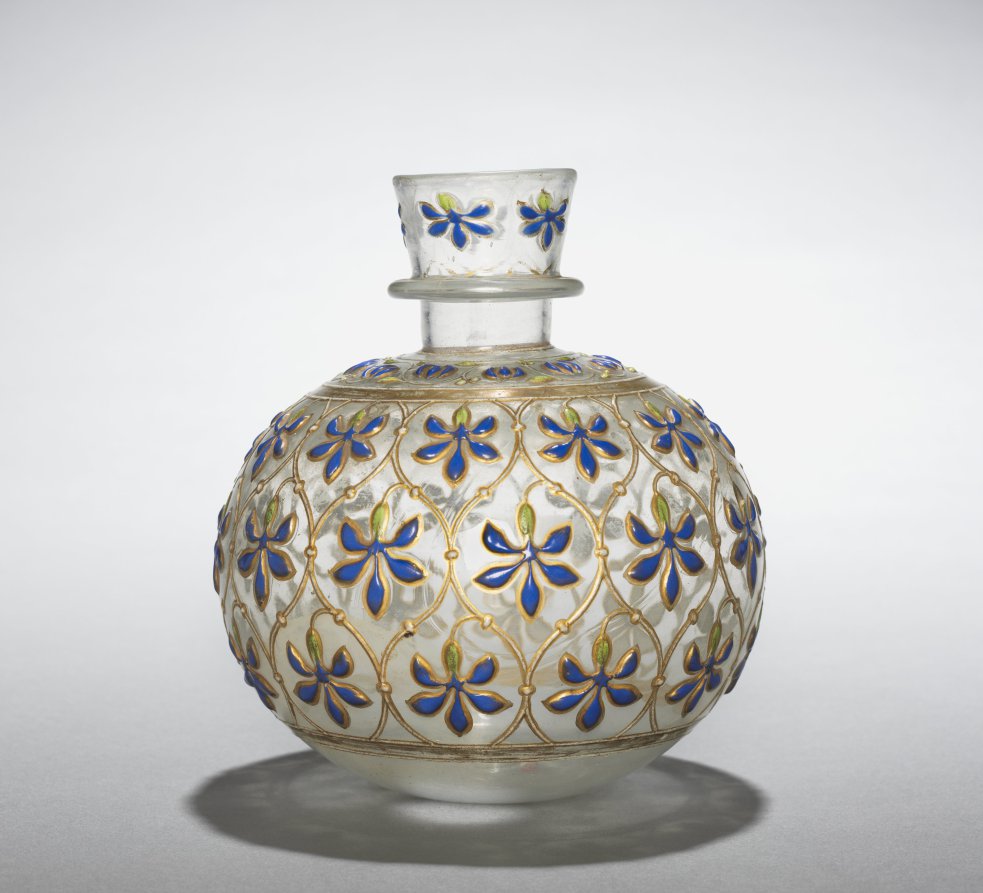
Description
Smoking tobacco was introduced to the Mughal court from Iran in the very early 1600s and soon became popular. This base formed part of a hookah, or water pipe, which consisted of a base that held water—sometimes perfumed with herbs or fresh fruit—a detachable bowl to hold tobacco, and a long tube. Early hookahs used existing vessels for bases, including coconut shells. By the late 1600s or early 1700s, richly decorated pieces like this were produced. The jewel-like decoration of blue and green blossoms evokes a garden in which a smoker might have sat.
Provenance
Mrs. R. Henry [Emery May Holden] Norweb [1895–1984], Cleveland, OH, given to the Cleveland Museum of Art (?–1969); The Cleveland Museum of Art, Cleveland, OH (1969–)
Accession Number
1969.286
Medium
Glass with colored enamel and gilding
Dimensions
Overall: 17.8 cm (7 in.)
Classification
Glass
Credit Line
The Norweb Collection