Description
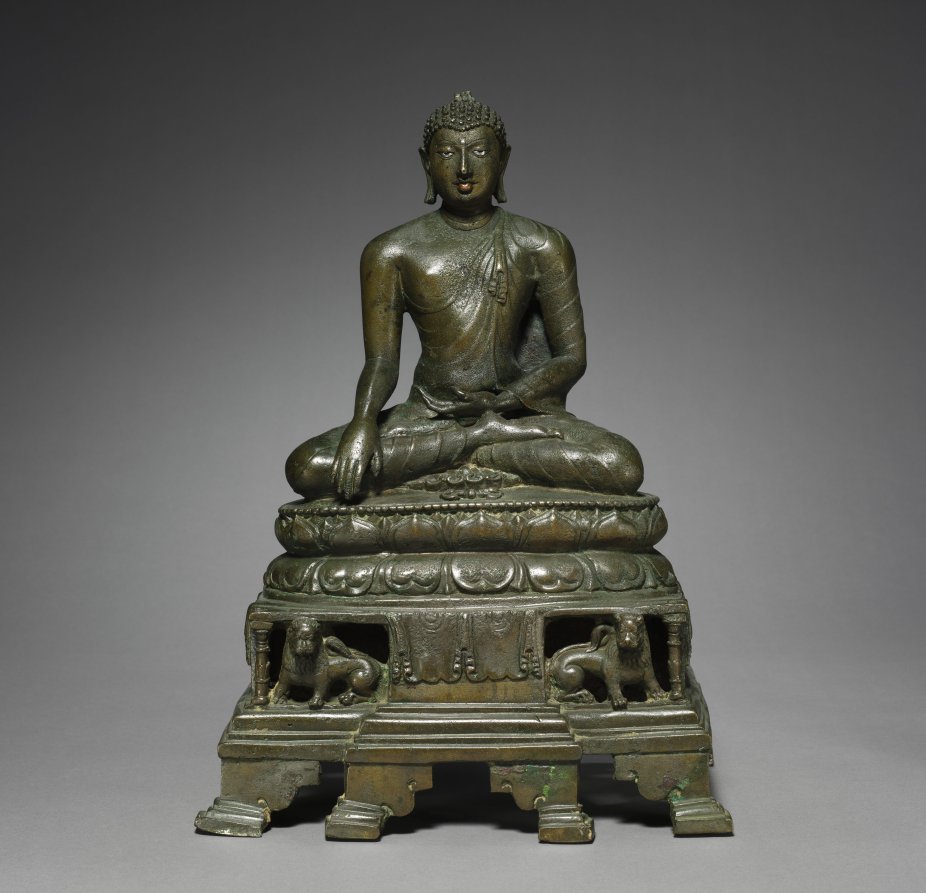
Made during the Pala period (750-1134) when tantric imagery was first emerging in northeastern India, this sculpture is from a cache that yielded some of the most masterful works of the north Indian bronze tradition. From this region, Tantra spread to Southeast Asia. The double-headed thunderbolt, or vajra, placed on top of the pedestal in front of the figure indicates that this is a tantric image. His hand gestures identify him as one of the Five Cosmic Buddhas, each of whom is associated with a cardinal direction of space: north, south, east, west, and center. The Buddha Akshobhya is especially invoked to eradicate the harmful emotion of anger.
Provenance
(I. Kahane, Inc., Zürich, Switzerland, sold to the Cleveland Museum of Art) (?-1970); The Cleveland Museum of Art, Cleveland, OH (1970-)
Accession Number
1970.10
Medium
bronze with silver and copper inlay
Dimensions
Overall: 38.8 x 26.3 cm (15 1/4 x 10 3/8 in.)
Classification
Sculpture
Credit Line
Purchase from the J. H. Wade Fund