Description
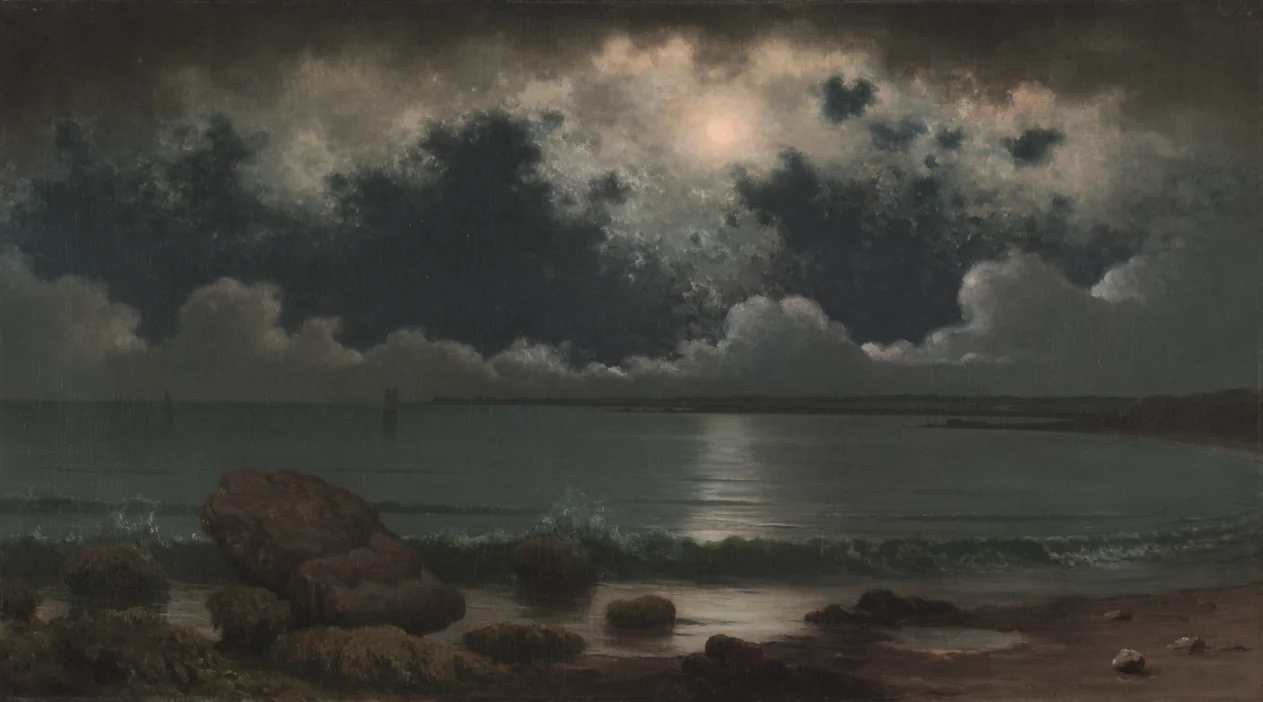
One of only a handful of nocturnal scenes painted by Heade, this evocative painting captures the effects of glimmering moonlight on land, sea, and sky. Although the artist depicts a specific location, his nighttime rendering shrouds most details in shadow, imparting a greater sense of mood than place. Human presence manifests itself through two sailing ships on the left side of the composition.
Provenance
The Cleveland Museum of Art, Cleveland, Ohio (1970-); (Hirschl & Adler Galleries, New York, NY, sold to the Cleveland Museum of Art) (1969-1970); James H. and Adeline [b. 1933] Anderson, consigned to Hirschl & Adler 1 (Probably 1969); Lucy Joseph Harris, Providence and Little Compton, RI, by descent to her daughter and son-in-law, Adeline and James H. Anderson (1953-1969); Benjamin P. Harris, Jr. [1901-1953], Providence, RI, by descent to his wife, Lucy Joseph Harris (1944-1953); Mona Elizabeth Tower Harris [1871-1944], Providence, RI, by descent to her son, Benjamin P. Harris, Jr. (1943=1944); Benjamin P. Harris, Providence, RI [1873-1943], by descent to his wife, Mona Elizabeth Tower Harris (1922-1943); Sarah Bullock Harris [1834-1922], Providence, RI, by descent to her son, Benjamin P. Harris (By 1898-1922); Thomas Harris [1825-1898], Providence, RI, by descent to his wife, Sarah Bullock Harris
Accession Number
1970.161
Medium
oil on canvas
Dimensions
Framed: 97 x 153.5 x 14 cm (38 3/16 x 60 7/16 x 5 1/2 in.); Unframed: 72.3 x 128 cm (28 7/16 x 50 3/8 in.)
Classification
Painting
Credit Line
Mr. and Mrs. William H. Marlatt Fund and Gift of Delbert Gutridge in memory of Orrel A. Parker by exchange
Tags
Painting Impressionist & Modern (1851–1900) Oil Painting Canvas American Color: Brown Color: Gray
Background & Context
Background Story
Point Judith, the southern tip of Narragansett Bay where the open Atlantic meets Long Island Sound, gave Heade a coastal subject that combines the horizontal expanse of his marsh paintings with the vertical drama of lighthouses and rocky outcrops. The painting from 1867-68 shows Heade applying his atmospheric approach to a more dramatic coastal setting, where the flat horizontals of the marsh are interrupted by the vertical accent of the lighthouse and the structural complexity of the rocky shoreline. The result is a painting that maintains Heade's characteristic atmospheric subtlety while accommodating the more varied topography of the Rhode Island coast.
Cultural Impact
Point Judith was an important coastal landmark in the 19th century, and Heade's painting of it is both a landscape and a maritime document: the lighthouse that appears in the composition was a crucial navigation aid for ships entering Long Island Sound. The painting's 1867-68 date places it in the period when Heade was moving between his marsh subjects and his tropical subjects, and the Point Judith landscape shares characteristics with both: the atmospheric light of the marshes and the dramatic coastal setting of the tropics.
Why It Matters
Point Judith, Rhode Island is Heade's coastal landscape at its most dramatic: a lighthouse, rocky outcrops, and the open Atlantic, all rendered with the atmospheric subtlety that distinguishes his work from the more theatrical approach of his contemporaries. The lighthouse provides the vertical accent that the marshes lack, giving the composition a structural variety that Heade rarely achieved in his interior landscapes.
![Saint Bernard and Saint Catherine of Alexandria with the Virgin of the Annunciation [right panel]](https://api.nga.gov/iiif/e6890364-4d99-4684-a62b-5060ee3c3446/full/400,/0/default.jpg)