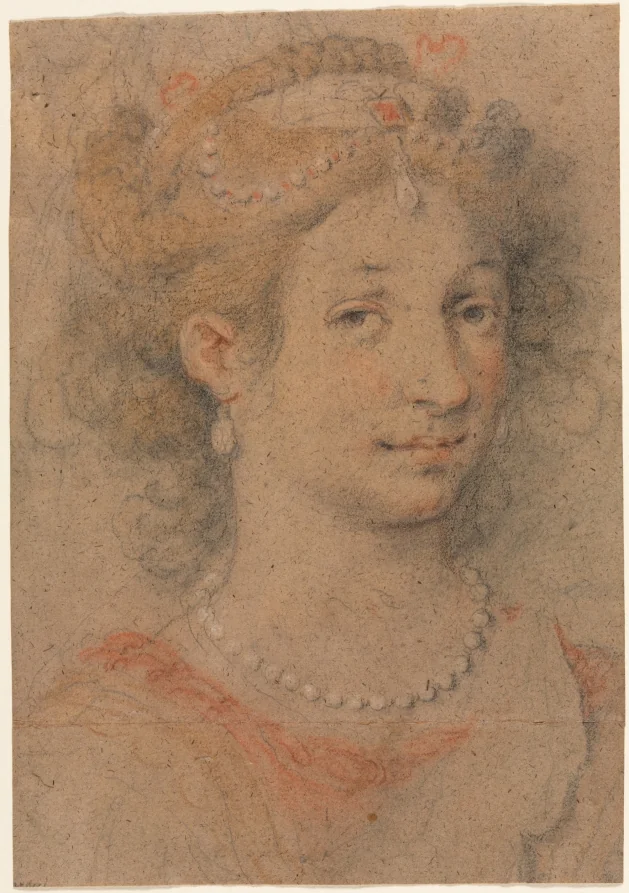
Accession Number
1970.359
Medium
black and red chalk over graphite, heightened with white chalk (with additions? in yellow and orange pastel?)
Dimensions
Sheet: 23 x 16 cm (9 1/16 x 6 5/16 in.)
Classification
Drawing
Credit Line
Gift of Dr. and Mrs. Sherman E. Lee for the fiftieth anniversary of The Print Club of Cleveland
Tags
Drawing Baroque (1600–1750) Pastel Graphite & Pencil Color: Orange
Background & Context
Background Story
This anonymous 17th-century head study demonstrates the academic drawing technique of combining red and black chalk (aux deux crayons) with white chalk highlights on a toned ground. The addition of yellow and orange pastel suggests that the drawing was reworked at a later date, perhaps by a different artist who wanted to develop it further. The head study—the most fundamental exercise in academic drawing—reveals the artist's training and skill in rendering the three-dimensional form of the face through the subtle manipulation of light and shadow across the curves of the forehead, cheeks, and jaw.
Cultural Impact
The combination of red and black chalk was one of the standard academic drawing techniques of the 17th century, used for figure studies, head studies, and compositional drawings. The anonymous artist of this head study was clearly trained in the academic tradition, but the quality of the drawing makes attribution to a specific artist or school difficult—several national traditions produced drawings of this quality and technique.
Why It Matters
Head of a Woman is academic drawing at its most fundamental: a face rendered in red and black chalk with white highlights, the three-dimensional form emerging from the toned ground through the careful manipulation of light and shadow. The anonymous artist's skill is undeniable; their identity is lost.