Description
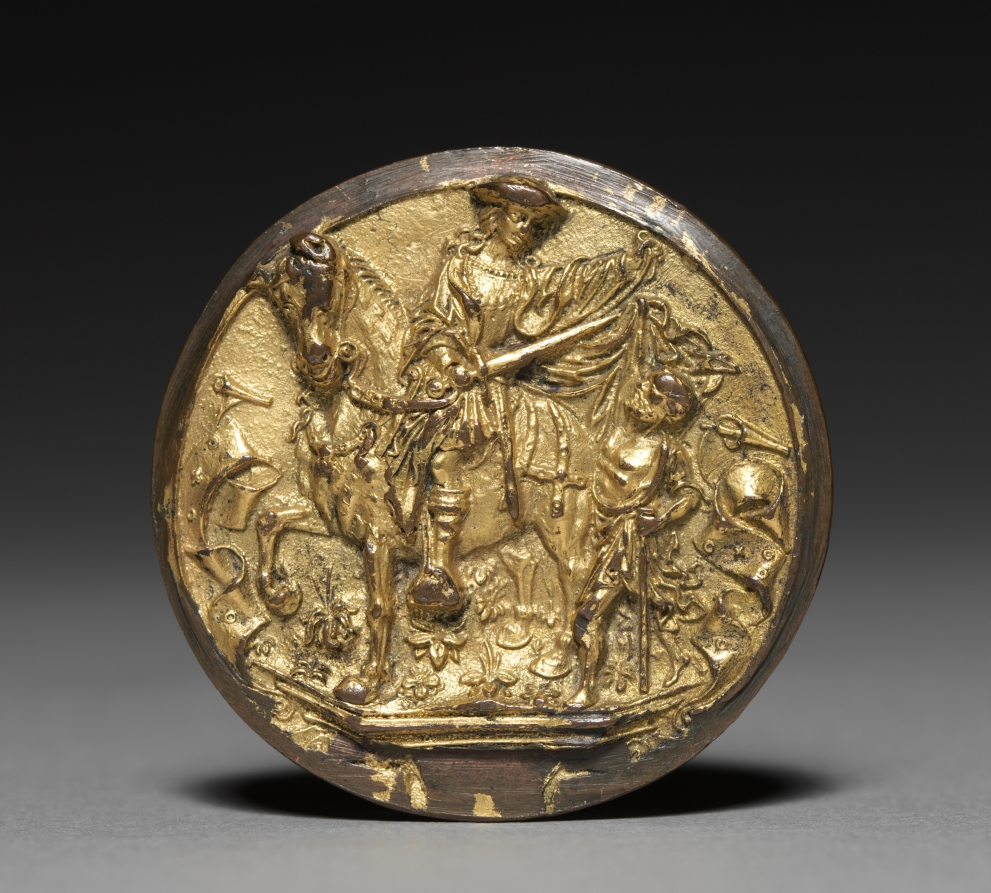
This plate is an appliqué seal, intended as a decorative element for a garment or possibly as a simple pilgrimage medallion. The work tells a story of charity. It depicts Martin of Tours, a French soldier of the fourth century who, when accosted by a beggar at the gates of Amiens, cut a portion of his cloak and gave it to him. Saint Martin is depicted midway through cutting away his cloak with his saber. The bronze is often attributed to an artist in the northern Netherlands, which is due in part to the popularity of several motifs there at the turn of the sixteenth century. The depiction of plant life, for instance, is highly detailed, recalling Netherlandish scenes of the time. A similar seal (now in Berlin) belonged to Johann Potken, who was the provost of the Monastery of Saint Martin. This monastery was located in the now-German city of Emmerich am Rhein, not far from the Dutch city of Nijmegen. Despite the seal's Germanic attributes, the figures' physical qualities suggest the artist's awareness of Italian Renaissance art.
Provenance
Julius Böhler (Munich, Germany), 1971, sold to the Cleveland Museum of Art, 1971.
Accession Number
1971.163
Medium
gilt bronze
Dimensions
Diameter: 4.5 cm (1 3/4 in.)
Classification
Sculpture
Credit Line
Gift of Mrs. Chester D. Tripp