Description
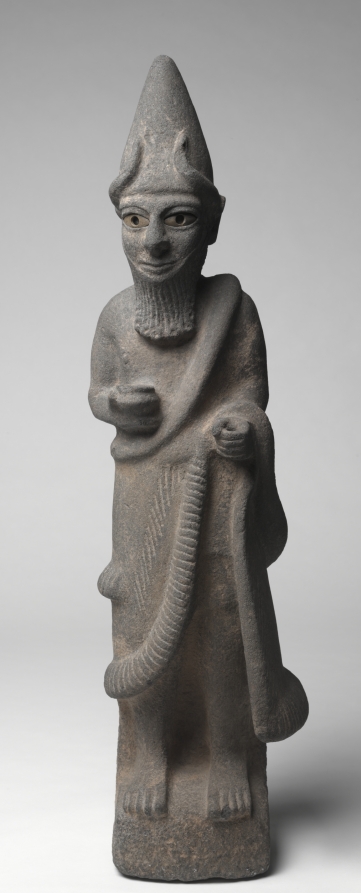
The Hittites migrated into Anatolia in the 3rd millennium BCE and spoke an Indo-European language, a group that includes Greek, Latin, Persian, Sanskrit, English, and most modern European languages. They were the first ancient people to use iron for weapons. From about 1600–1200 BCE their empire was at its peak, extending from central Anatolia to Syria, and south along the eastern Mediterranean. Their vast empire and interest in commerce enabled the Hittites to spread Mesopotamian ideas and culture throughout the ancient Mediterranean world. This large basalt sculpture is exceptionally rare in depicting a Hittite god or priest-king wearing a horned conical crown, false beard, and long robe. He holds a bowl in his right hand and once held something in his left, perhaps a staff or sword.
Provenance
Mrs. Maguerite Mallon, Sold to the Cleveland Museum of Art (?-1971); The Cleveland Museum of Art, Cleveland, OH (1971-)
Accession Number
1971.45
Medium
basalt with bone eyes (left, ancient; right, restored)
Dimensions
Overall: 87.6 cm (34 1/2 in.)
Classification
Sculpture
Credit Line
Leonard C. Hanna Jr. Fund