Description
The grandest of the Buddhist mortuary rites is the Water-Land (shuilu) ritual. This esoteric ceremony is conducted for the salvation of “all souls of the dead on land and sea.” The ostentatious ritual was performed for imperial ancestors and high officials from the Song (960–1279) to the Ming dynasties and drew large crowds. On the second day of the weeklong ceremony, paintings are hung in the inner altar.
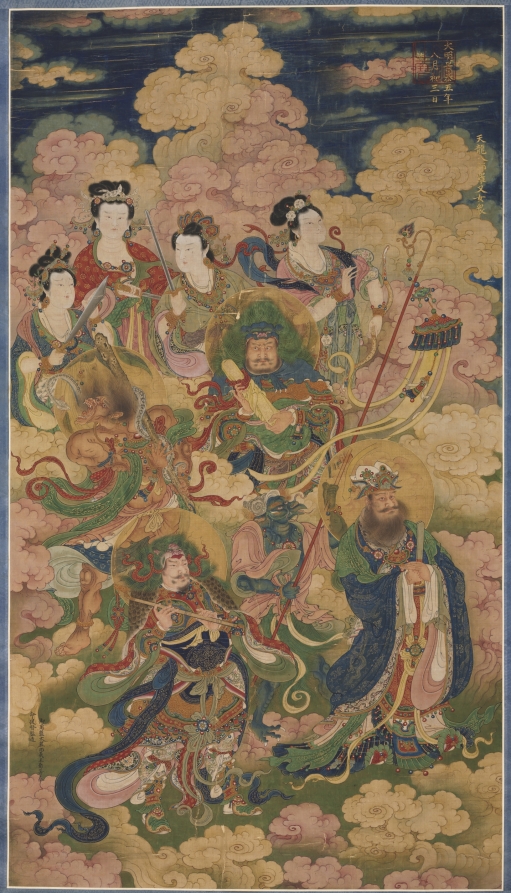
This scroll represents the Eight Hosts of Celestial Nagas and Yakshis as described in the Lotus Sutra. Together with CMA 1973.70.1, it belongs to a set of 36 Water-Land ritual paintings that are the finest works of their types known from the Ming period. With their bright, opaque color and fine-line gilt decoration intact and unfaded, both paintings share a remarkable state of preservation.
This scroll represents the Eight Hosts of Celestial Nagas and Yakshis as described in the Lotus Sutra. Together with CMA 1973.70.1, it belongs to a set of 36 Water-Land ritual paintings that are the finest works of their types known from the Ming period. With their bright, opaque color and fine-line gilt decoration intact and unfaded, both paintings share a remarkable state of preservation.
Provenance
Ming imperial collection [Jingtai era, 1450–1456] (1450–1456); (Shunichi Yabumoto Co., Ltd., Tokyo, Japan, sold to the Cleveland Museum of Art) (?-1973); The Cleveland Museum of Art, Cleveland, OH (1973-)
Accession Number
1973.70.2
Medium
hanging scroll; ink and color on silk
Dimensions
Painting: 140.2 x 78.8 cm (55 3/16 x 31 in.); Overall with knobs: 226.5 x 120 cm (89 3/16 x 47 1/4 in.)
Classification
Painting
Credit Line
John L. Severance Fund