Accession Number
1974.231
Medium
brush and wash
Dimensions
Sheet: 15.2 x 23.9 cm (6 x 9 7/16 in.)
Classification
Drawing
Credit Line
Gift of Mrs. Lewis B. Williams
Tags
Drawing Early Modern (1901–1950) British Color: White
Background & Context
Background Story
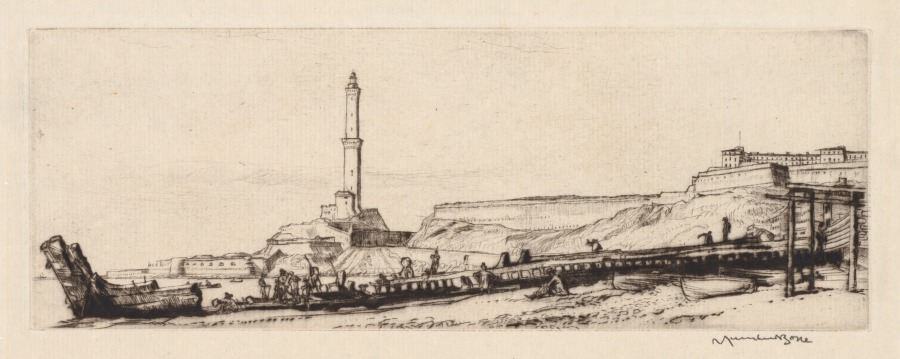
The Venetian lagoon is one of the most painted subjects in European art, and Bone's brush-and-wash treatment is among the most stripped-down and atmospheric. By eliminating the precise architectural detail that distinguishes his etchings and graphite drawings, Bone creates a vision of Venice that is almost abstract — a composition of light, water, and atmosphere where the city's buildings emerge from and dissolve into the lagoon's luminosity. The brush-and-wash medium is the most fluid and least linear of Bone's techniques, producing an effect closer to Chinese ink painting than to Western architectural drawing.
Cultural Impact
Bone's Venetian lagoon drawing belongs to the great tradition of Venetian watercolor painting that includes Turner, Sargent, and Whistler. But where Turner dissolved Venice in light and Sargent captured its social life, Bone reduces it to structure — the lagoon's horizontal expanse, the vertical accents of campanili and chimneys, and the tonal relationships between water, buildings, and sky. It is a Venetian view that an architect would make.
Why It Matters
Lagoon, Venice is Bone's Venice at its most essential: reduced to structure and atmosphere by the brush-and-wash medium that eliminates architectural detail in favor of tonal relationships. The result is Venice as pure landscape — water, light, and the vertical accents that prove human beings were here.