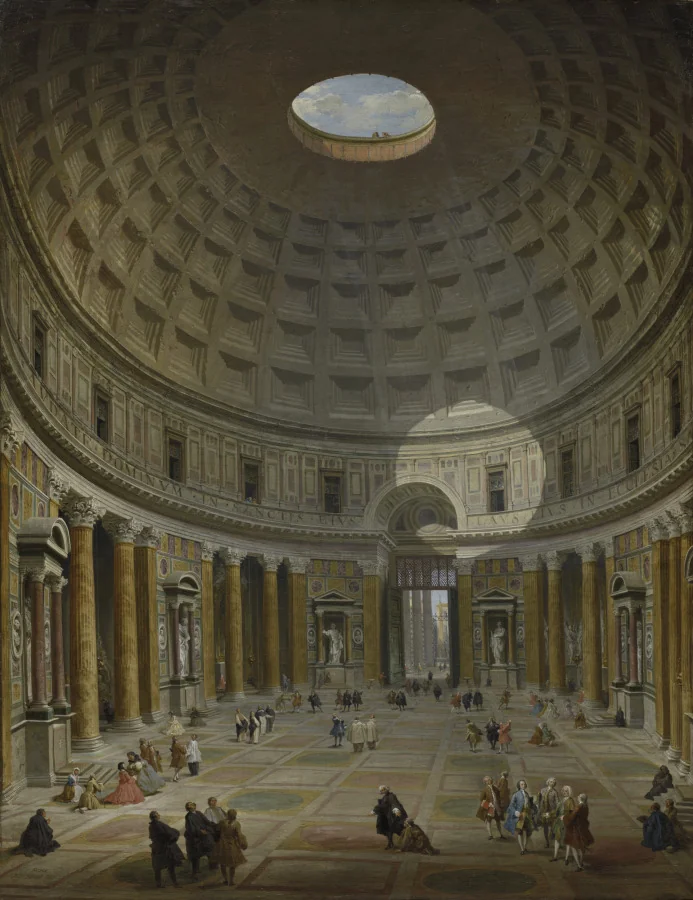
Description
Created as a temple under the Roman emperor Hadrian around the year AD 125, the Pantheon became a Christian church in 609. Significant restoration took place in the early 1700s, a period of renewed attention to early Christian monuments. The site was a major monument of antiquity, an active church, and its portico, visible through the door, held the most important art fair in the city. Panini shows the complexity of this public space by representing foreign tourists, local churchgoers, Roman nobles, and artists mingling under the dome.
Provenance
Tyrwhitt-Drake ("Shardeloes," Amersham, Buckinghamshire, UK) (sold, Christie’s, London, July 25, 1952, no. 148, to Reder); 1952 - Reder; David Koetser (New York, New York); - 1969 Walter P. Chrysler; 1969 - 1974 Eugene V. Thaw (New York, New York), sold to the Cleveland Museum of Art.
Accession Number
1974.39
Medium
oil on canvas
Dimensions
Framed: 147.5 x 120 x 5 cm (58 1/16 x 47 1/4 x 1 15/16 in.); Unframed: 127 x 97.8 cm (50 x 38 1/2 in.)
Classification
Painting
Credit Line
Purchase from the J. H. Wade Fund
Tags
Painting Baroque (1600–1750) Oil Painting Canvas Italian Color: Brown
Background & Context
Background Story
This second version of Interior of the Pantheon from 1747 shows Panini returning to his most popular subject with the increased compositional sophistication and atmospheric subtlety that distinguish his later work. The 1747 date places this more than a decade after the earlier version, and the comparison reveals how Panini's treatment of the Pantheon evolved over the course of his career—the later version shows more accomplished handling of light and space, and the figures in the interior are arranged with greater compositional sophistication than in the earlier version.
Cultural Impact
The two versions of Interior of the Pantheon in the National Gallery allow a direct comparison of Panini's early and late treatments of his most popular subject, demonstrating the evolution of his style over more than a decade. The 1747 version shows increased compositional sophistication and atmospheric subtlety, with the figures in the interior arranged with greater care and the handling of light and space more accomplished than in the c. 1734 version.
Why It Matters
Interior of the Pantheon (1747) is Panini returning to his most popular subject with increased compositional sophistication: the Pantheon interior rendered with more accomplished handling of light and space than the earlier c. 1734 version. The two paintings together demonstrate the evolution of Panini's style over more than a decade.
![Saint Bernard and Saint Catherine of Alexandria with the Virgin of the Annunciation [right panel]](https://api.nga.gov/iiif/e6890364-4d99-4684-a62b-5060ee3c3446/full/400,/0/default.jpg)