Description
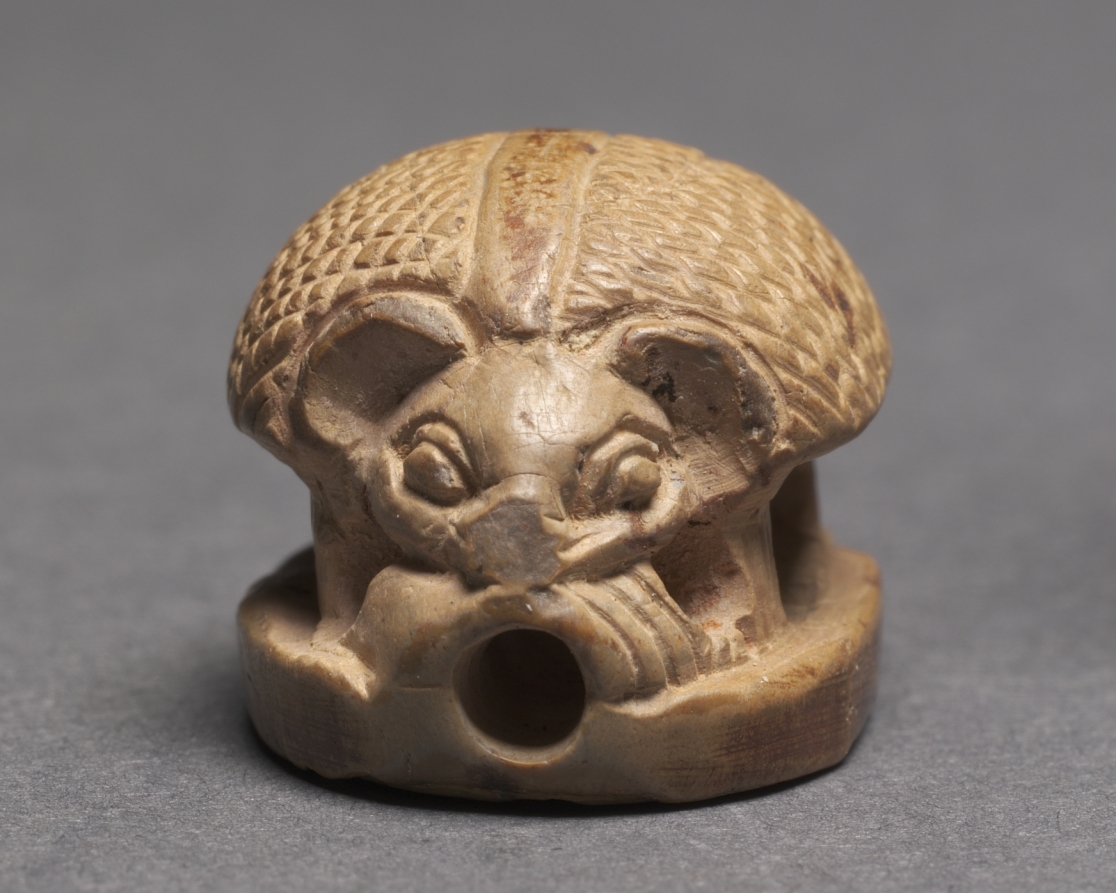
This hedgehog (Paraechinus aethiopicus) stands in the round on an oval base, with openwork defining the legs. The carving is delicate and spirited. The face features large, round eyes; widely spaced, short ears; bulging cheeks; and a protruding snout. A tiny tail hangs at the rear. Crosshatching on the back represents the animal's spines. The design on the base begins at the head with a winged sun disk with pendant uraei. Below is a cluster of hieroglyphic signs, including an ankh-sign, a falcon with a sun disk, a hoe, and a maat-feather. A neb-sign fills the balance below.
The significance of the hedgehog has multiple theories. As a hibernating animal, it may have associated with the powers of self-renewal and resurrection. Another lies in the animal's defensive strategy of inflating itself into a ball and projecting its spines, a posture of obvious apotropaic significance. Lastly, Egyptian folklore maintained that hedgehog amulets provided protection against snake bites, a belief grounded in the animal's natural resistance to poison.
The significance of the hedgehog has multiple theories. As a hibernating animal, it may have associated with the powers of self-renewal and resurrection. Another lies in the animal's defensive strategy of inflating itself into a ball and projecting its spines, a posture of obvious apotropaic significance. Lastly, Egyptian folklore maintained that hedgehog amulets provided protection against snake bites, a belief grounded in the animal's natural resistance to poison.
Provenance
The Cleveland Museum of Art, Cleveland, OH (1975-)
Accession Number
1975.24
Medium
steatite, originally glazed
Dimensions
Overall: 1.7 x 1.8 cm (11/16 x 11/16 in.)
Classification
Scarabs
Credit Line
Guerdon S. Holden Memorial Fund