Description
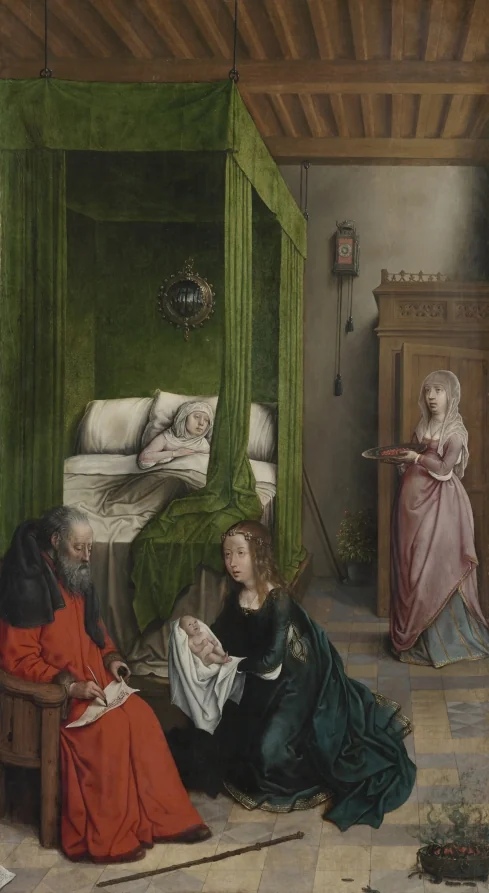
Typical of Flemish art of the period, this scene suggests a comfortable home of the late 1400s in the Netherlands to frame the story of a biblical birth. Elizabeth, mother of Saint John the Baptist, rests after her labor, while her cousin, the Virgin Mary, presents the newborn to his father, Zacharias. Having lost his ability to speak when he doubted an angel’s prophecy of the child’s birth, Zacharias writes down his son’s name. At this moment, his speech is restored. This painting was once part of an altarpiece commissioned by Queen Isabella I of Castile, known as the Catholic (1451–1504), for a monastery near Burgos.
Provenance
Monastery of Miraflores, Spain; (Frederick Mont, New York, sold to the Cleveland Museum of Art) (?-1975); The Cleveland Museum of Art, Cleveland, OH (1975-)
Accession Number
1975.3
Medium
oil on wood
Dimensions
Framed: 99 x 60 x 7.5 cm (39 x 23 5/8 x 2 15/16 in.); Unframed: 88.4 x 49.9 cm (34 13/16 x 19 5/8 in.)
Classification
Painting
Credit Line
John L. Severance Fund
Tags
Painting Renaissance (1400–1599) Oil Painting Netherlandish Color: Green
Background & Context
Background Story
Juan de Flandes (active 1496-1519) was a Flemish painter who worked in Spain, known for the precise, detailed manner that makes him one of the most important painters of the early Spanish Renaissance. The Birth and Naming of John the Baptist from 1496-99 depicts the biblical episode in the precise, detailed manner that distinguishes Juan de Flandes's best religious paintings from the more generalized work of his Spanish contemporaries. The 1496-99 date places this at the beginning of Juan de Flandes's career in Spain, when he was brought to the court of Queen Isabella I of Castile to produce the precise, detailed religious paintings that are his most accomplished works.
Cultural Impact
The Birth and Naming of John the Baptist is important in the history of Spanish painting because it demonstrates the precise, detailed Flemish manner that Juan de Flandes brought to the Spanish court. The introduction of Flemish precision and detail to Spanish painting by Juan de Flandes and other Flemish painters represented an important influence on the development of Spanish Renaissance painting, and the 1496-99 painting shows this Flemish influence at its most accomplished.
Why It Matters
The Birth and Naming of John the Baptist is Juan de Flandes bringing Flemish precision to the Spanish court: the biblical episode rendered in the exact, detailed manner that Queen Isabella's Flemish court painter introduced to Spanish Renaissance painting. The 1496-99 painting shows the Flemish influence at its most accomplished in early Spanish painting.

![Saint Bernard and Saint Catherine of Alexandria with the Virgin of the Annunciation [right panel]](https://api.nga.gov/iiif/e6890364-4d99-4684-a62b-5060ee3c3446/full/400,/0/default.jpg)