Description
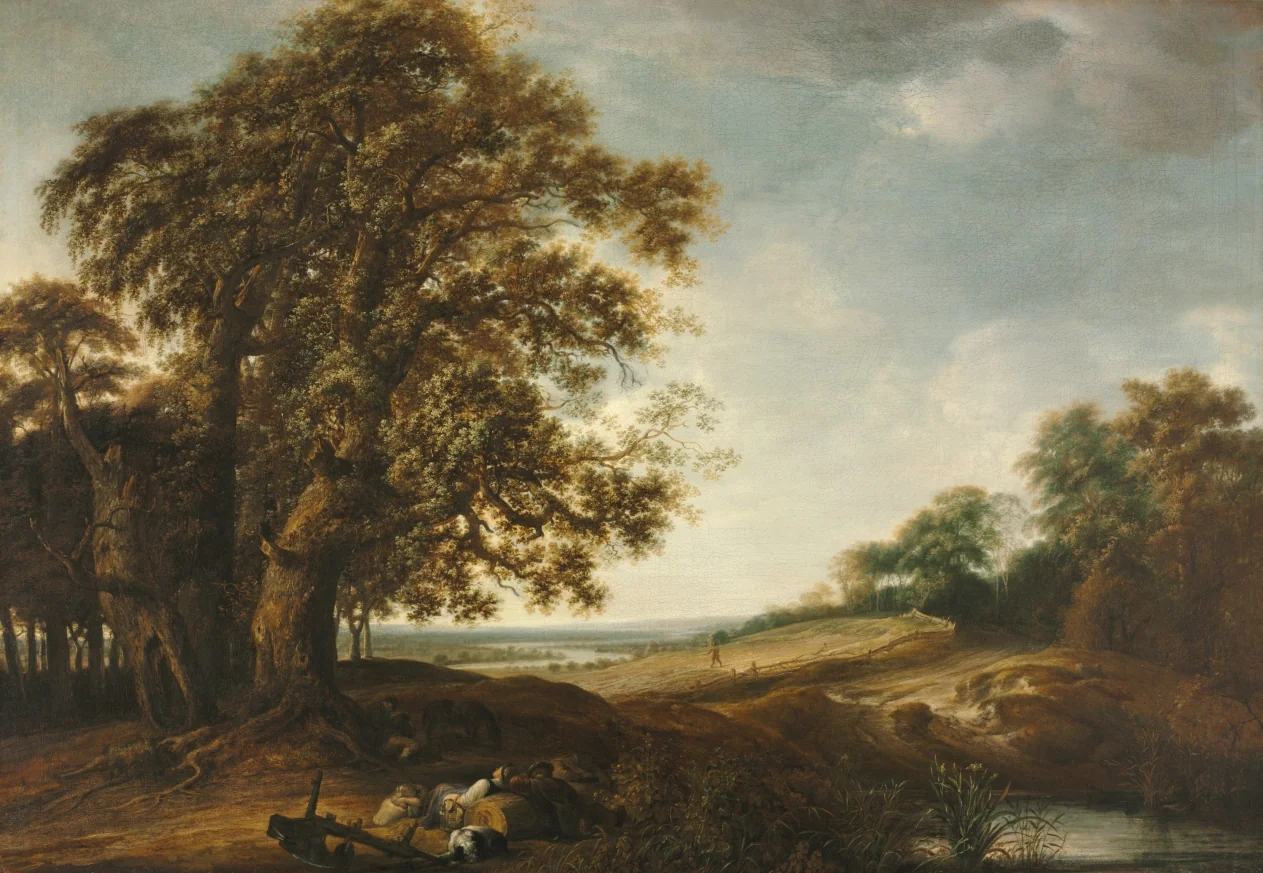
During the 1600s Protestant leaders denounced visual representations, in a belief that a strict understanding of the scriptures was the only way to achieve salvation. As a result, Protestants did not generally commission religious images. However, where religious painting did appear, they often depicted verses from the Bible with strict didactic values, such as Sleeping Peasants near Fields (Parable of the Weeds). The subject of this painting is the Parable of the Weeds from Matthew 13:24-30. Simon de Vlieger has illustrated the point in the story where the peasants sleep after sowing good seeds, and the enemy, depicted here as a satyr, mixes in bad seeds in the fields as well. When the weeds begin to grow, confused, the peasants ask the farmer if they should remove the seeds. The farmer replies that they should let the weeds and wheat grow together, and he will destroy the weeds after the harvest. The lesson of the story is that good and evil people often mix together; but in the end the pious will prevail and the wicked will be destroyed.
Provenance
- Hon. Frederick George Lindley Meynell; -1974 Charles Meynell, sold, London, Sotheby's and Company, 03/27/1974, no. 7, pl. 7; 1774-1975 [Frederick Mont, New York), sold to the Cleveland Museum of Art, 1975
Accession Number
1975.76
Medium
oil on canvas
Dimensions
Framed: 122 x 161.5 x 8 cm (48 1/16 x 63 9/16 x 3 1/8 in.); Unframed: 90.4 x 130.4 cm (35 9/16 x 51 5/16 in.)
Classification
Painting
Credit Line
Mr. and Mrs. William H. Marlatt Fund
Tags
Painting Baroque (1600–1750) Oil Painting Canvas Dutch Color: Gold
Background & Context
Background Story
Simon de Vlieger (1601-1653) was a Dutch painter known for the atmospheric, precisely observed landscape and marine paintings that make him one of the most important painters of the Dutch Golden Age. Sleeping Peasants near Fields (Parable of the Weeds) from 1650-53 depicts sleeping peasants near fields with the biblical parable of the weeds in the atmospheric, precisely observed manner that distinguishes de Vlieger's best work from the more general landscape painting of his contemporaries. The 1650-53 date places this in de Vlieger's most productive period, when he was producing the atmospheric, precisely observed landscapes that are his most accomplished works, and the parable subject shows his ability to combine biblical narrative with landscape.
Cultural Impact
Sleeping Peasants near Fields is important in the history of Dutch landscape painting because it demonstrates the atmospheric, precisely observed manner that de Vlieger brought to landscape as one of the most important painters of the Dutch Golden Age. De Vlieger's atmospheric, precisely observed landscapes—combining biblical narrative with landscape in the manner of the Dutch landscape tradition—represent one of the most accomplished traditions in Dutch Golden Age painting, and the 1650-53 painting shows this tradition at its most atmospheric and precisely observed.
Why It Matters
Sleeping Peasants near Fields is de Vlieger's atmospheric Dutch landscape: the parable of the weeds rendered in the precisely observed manner of one of the most important painters of the Dutch Golden Age. The 1650-53 painting shows the combination of biblical narrative with atmospheric landscape that makes de Vlieger one of the most accomplished Dutch landscape painters.