Description
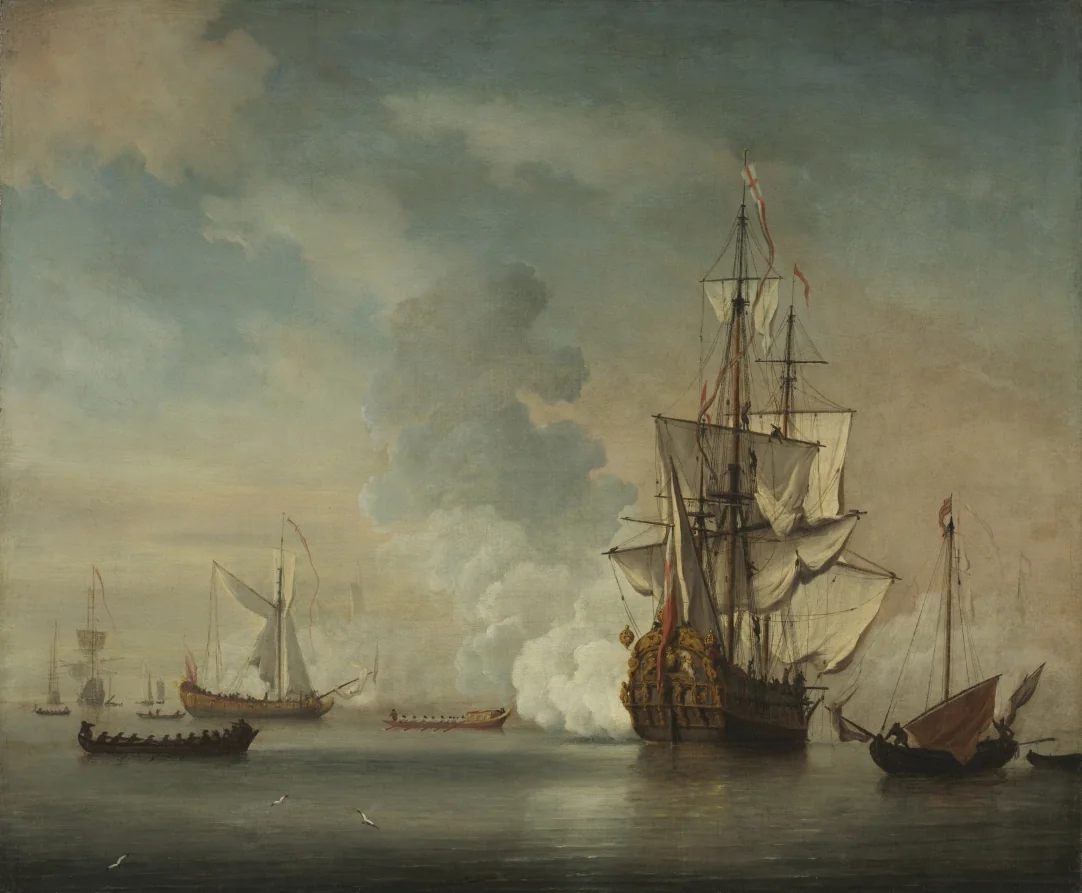
Van de Velde and his father picked up their lives in Amsterdam in 1672 and moved to England to paint for the king. Their paintings of the Royal Navy’s massive ships celebrated England’s power in war and trade.
Provenance
-1751 Charles Cavert (1699-1751), Fifth Lord Baltimore; 1751-1771 Frederick Calvert (1731-1771), Sixth Lord Baltimore; 1771-1835 Henry Harford (d. 1771); 1835-1885 Frederick Paul Harford, Down Place, Windsor, sold, Christie's London, 06/1885; - Rufus L. Patterson (1872-1943), New York; [Norton Galleries, New York]; 1968-1975 Mr. and Mrs. Noah L. Butkin, Cleveland, by gift to the Cleveland Museum of Art, 1975
Accession Number
1975.80
Medium
oil on canvas
Dimensions
Framed: 91 x 103 x 4 cm (35 13/16 x 40 9/16 x 1 9/16 in.); Unframed: 63.7 x 77.5 cm (25 1/16 x 30 1/2 in.)
Classification
Painting
Credit Line
Gift of Mr. and Mrs. Noah L. Butkin
Tags
Painting Baroque (1600–1750) Oil Painting Canvas Color: Brown Color: Gray
Background & Context
Background Story
English Warship Firing a Salute from 1690 depicts an English warship firing a salute in the precisely observed, maritime manner of the late 17th-century Dutch/English marine painting tradition. The 1690 date places this in the period following the Glorious Revolution of 1688, when English naval power was becoming one of the most important forces in European politics and the depiction of English warships was one of the most important subjects in marine painting. The precisely observed treatment of the warship shows the marine painting tradition at its most accomplished, with the details of the ship's rigging, sails, and cannon fire rendered with the precise observation that distinguishes the best marine painting of the period.
Cultural Impact
English Warship Firing a Salute is important in the history of marine painting because it demonstrates the precisely observed manner of the late 17th-century marine painting tradition as applied to English naval subjects. The depiction of English warships—one of the most important subjects in marine painting following the rise of English naval power—represents one of the most accomplished traditions in the genre, and the 1690 painting shows this tradition at its most precisely observed.
Why It Matters
English Warship Firing a Salute is an anonymous late 17th-century marine painting: an English warship firing a salute rendered in the precisely observed manner of the marine painting tradition. The 1690 painting shows the precise observation of naval subjects that makes marine painting one of the most accomplished genres of the period.