Description
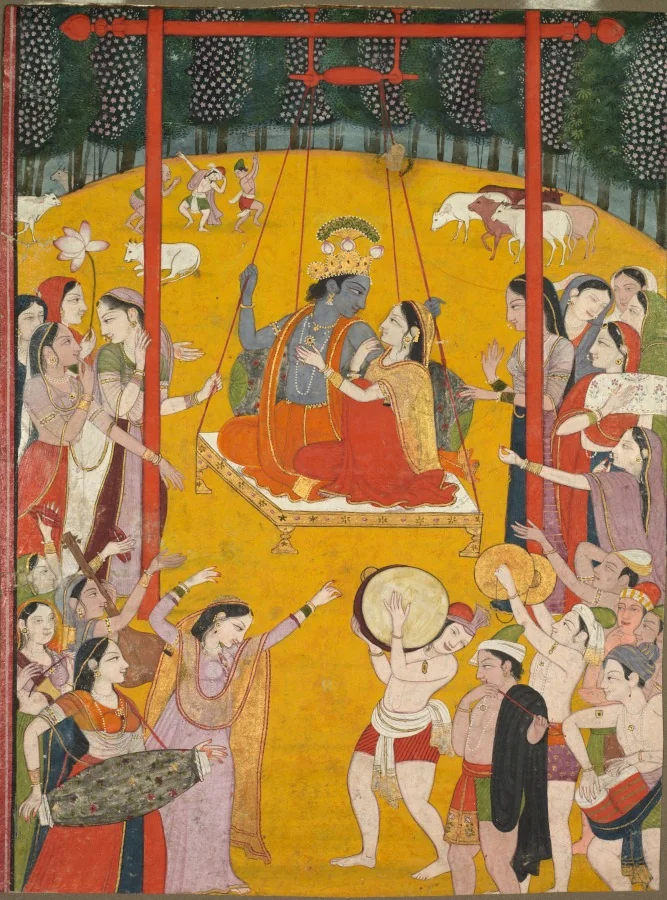
To celebrate the coming of spring, Krishna sits on a swing with his beloved Radha as their companions, the cowherd boys and milkmaids, play music, dance, admire the idyllic couple, and keep their swing gently in motion.
In Sanskrit, hindola means swing, and this painting belonged to a set of ragas, which are paintings associated with a musical mode. Music played in the Hindola Raga elicits the fever of young love in springtime. Radha and Krishna represent the ideal of a young couple in love.
In Sanskrit, hindola means swing, and this painting belonged to a set of ragas, which are paintings associated with a musical mode. Music played in the Hindola Raga elicits the fever of young love in springtime. Radha and Krishna represent the ideal of a young couple in love.
Provenance
(William Wolff, Inc., New York, NY, sold to the Cleveland Museum of Art) (?–1975); The Cleveland Museum of Art, Cleveland, OH (1975–)
Accession Number
1975.9
Medium
Gum tempera and gold on paper
Dimensions
Image: 20.5 x 15.3 cm (8 1/16 x 6 in.); with mat: 35.5 x 25.4 cm (14 x 10 in.)
Classification
Painting
Credit Line
Edward L. Whittemore Fund
Tags
Painting Neoclassical & Romantic (1751–1850) Tempera Gold Leaf Paper Color: Gold
Background & Context
Background Story
Hindola Raga from c. 1790-1800 depicts the Hindola Raga—a musical mode associated with the swing festival of the monsoon season—in the richly colored, narrative manner of the Indian miniature painting tradition. The Hindola Raga is one of the most important musical modes in Indian classical music, associated with the joy and romance of the monsoon season, and paintings depicting it represent one of the most accomplished traditions in Indian miniature painting. The c. 1790-1800 date places this in the period when Indian miniature painting was producing some of its most accomplished works, and the richly colored treatment shows the Indian miniature tradition at its most refined.
Cultural Impact
Hindola Raga is important in the history of Indian painting because it demonstrates the richly colored, narrative manner of the Indian miniature painting tradition as applied to one of the most important musical modes in Indian classical music. The Hindola Raga—associated with the joy and romance of the monsoon season—is one of the most important musical modes in Indian classical music, and paintings depicting it represent one of the most accomplished traditions in Indian miniature painting. The c. 1790-1800 painting shows this tradition at its most richly colored.
Why It Matters
Hindola Raga is an anonymous Indian miniature: the musical mode associated with the monsoon swing festival rendered in the richly colored manner of the Indian miniature painting tradition. The c. 1790-1800 painting shows the rich color and narrative detail that make Indian miniature painting one of the most accomplished traditions in the history of art.