Description
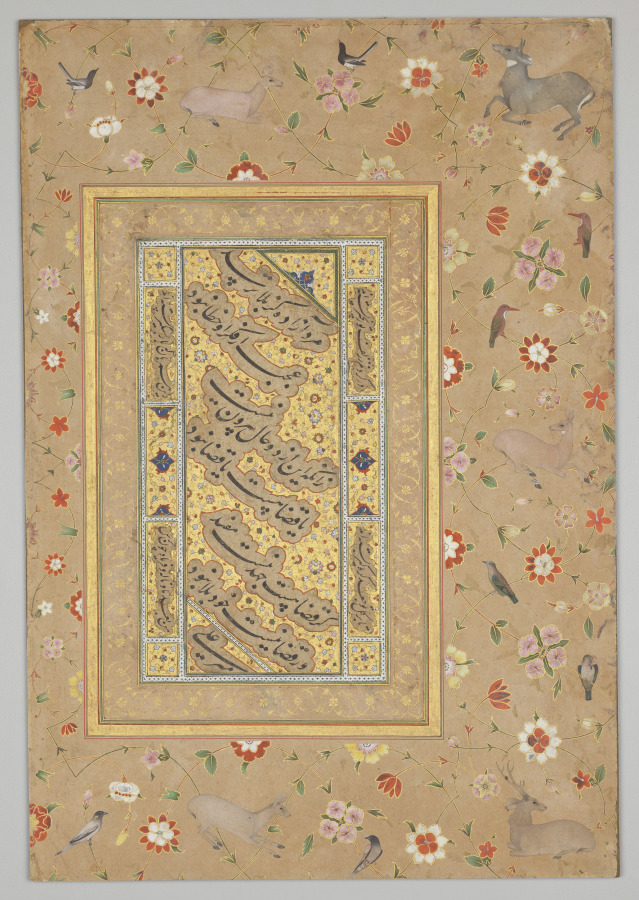
About 100 years after the calligraphy was completed by a Persian master and embellished with gold and floral arabesques, the small page was mounted into an album for the Mughal emperor of India. Mughal artists filled the outer border with floral vines, blooming and budding with many varieties. Pairs of birds perch throughout; male and female deer relax, listening to the birdsong. The Indian artists chose to emphasize nature’s abundance and life-giving forces, whereas the Persian artists sought to achieve exquisite, gemlike refinement.
The central poem, by Ibn-i Yamin (Persian, 1286–1368), encourages the reader not to worry about unexpected calamities.
The central poem, by Ibn-i Yamin (Persian, 1286–1368), encourages the reader not to worry about unexpected calamities.
Provenance
Herbert F. Leisy [1900–1977], Cleveland Heights, OH, given to the Cleveland Museum of Art (?–1977); The Cleveland Museum of Art, Cleveland, OH (1977–)
Persian calligraphy framed by an ornamental border of flowers, birds, and deer, from the Late Shah Jahan Album
calligraphy: c. 1500–1540; border: c. 1630–40
Accession Number
1977.207
Medium
Gum tempera, gold, and ink on paper
Dimensions
Overall: 36.8 x 25.2 cm (14 1/2 x 9 15/16 in.)
Classification
Painting
Credit Line
Gift of Herbert F. Leisy in memory of his wife, Helen Stamp Leisy
![Saint Bernard and Saint Catherine of Alexandria with the Virgin of the Annunciation [right panel]](https://api.nga.gov/iiif/e6890364-4d99-4684-a62b-5060ee3c3446/full/400,/0/default.jpg)