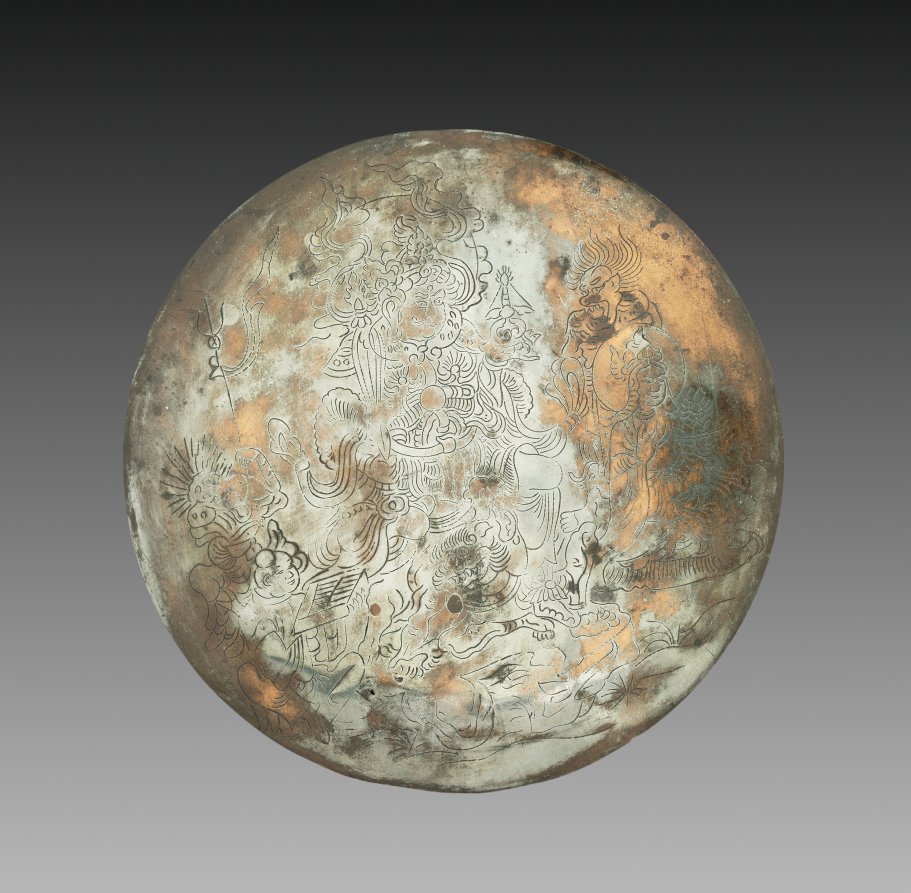
Description
Bishamonten, the Buddhist guardian of the North, appears here with an entourage. Early votive mirrors like this one are called kyōzō, literally “mirrors with images.” One theory is that they appeared along with the development of Shinto-Buddhist combinatory thought, in which specific Buddhist deities were identified with specific kami, or Shinto deities. In this theory, sacred mirrors venerated as proxies for kami came to be incised with images of Buddhist deities. Another idea is that they developed in the context of Esoteric Buddhist ritual.
Provenance
H. Minkenhof; (Shunichi Yabumoto Co., Ltd., Tokyo, Japan, sold to the Cleveland Museum of Art) (?–1977); The Cleveland Museum of Art, Cleveland, OH (1977–)
Accession Number
1977.32
Medium
silvered bronze with incised design
Dimensions
Diameter: 15.3 cm (6 in.)
Classification
Metalwork
Credit Line
The Severance and Greta Millikin Purchase Fund