Description
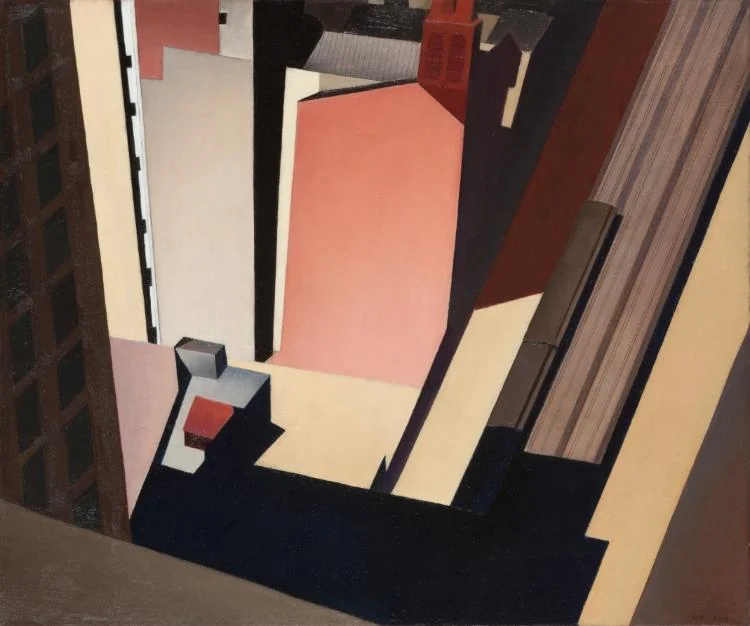
Capturing the soaring heights of New York City, this painting is a dramatic bird's-eye view of Broadway and Wall Street, showing a conglomeration of buildings at left and center, and the Church Street elevated train at right. Sheeler based his composition on an image from the short movie Manhatta (1920-21), which he made with the photographer Paul Strand. One of the first avant-garde American films, Manhatta celebrates the dynamic metropolis through a series of carefully composed shots of Lower Manhattan. As typical with Sheeler's work, the artist simplified forms and eliminated textures in Church Street El to concentrate on rhythmic interplay of shapes and color, and patterns of light and shadow.
Provenance
The Cleveland Museum of Art, Cleveland, Ohio (1977-); (Robert Schoelkopf Gallery, New York, NY, sold to the Cleveland Museum of Art) (-1977); (Harold Diamond, New York, NY) 1 (?); Elizabeth Lentz Horter [1900-1985], South Langhorne, PA (Probably 1940-at least 1969); Earl Horter [1880-1940], Philadelphia, PA 1 (By 1930-probably 1940)
Accession Number
1977.43
Medium
oil on canvas
Dimensions
Framed: 60 x 67.5 x 6 cm (23 5/8 x 26 9/16 x 2 3/8 in.); Unframed: 41 x 48.5 cm (16 1/8 x 19 1/8 in.)
Classification
Painting
Credit Line
Mr. and Mrs. William H. Marlatt Fund
Tags
Color: Red Color: White
Background & Context
Background Story
Charles Sheeler (1883–1965), a leading figure in American Precisionism, created "Church Street El" in 1920, capturing the elevated railway station at Church Street in Philadelphia. This oil on canvas represents a pivotal moment in Sheeler's career, when he was developing his signature style that merged Cubist-influenced structure with sharp-focus realism. Sheeler was both a painter and a photographer, and his dual practice deeply informed his artistic vision. The same year he painted "Church Street El," he also completed a photographic series of the same subject with his colleague Paul Strand.
The painting depicts the iron girders, stairways, and platform of the elevated train station with geometric precision. Sheeler reduces the complex structure to its essential forms—repeating verticals and diagonals, interlocking rectangles, and stark silhouettes. The color palette is restrained, dominated by grays, blacks, and earth tones, punctuated by the warm ochre glow of the station interior. Deep shadows and bright highlights create strong contrasts, lending the industrial architecture an almost mystical monumentality.
"Church Street El" belongs to Sheeler's most celebrated period. The painter was part of the circle around Alfred Stieglitz's 291 gallery and shared the modernist commitment to finding beauty in the American industrial landscape. Yet unlike the Futurists' celebration of speed and machine energy, Sheeler's vision is contemplative, almost reverent. The empty platform, devoid of passengers, transforms a utilitarian structure into a cathedral of modern life. This painting remains one of the defining works of the Precisionist movement, which sought to articulate a distinctly American modernist idiom through the clean lines of industrial and architectural forms.
Cultural Impact
Sheeler's Precisionism shaped the visual identity of American modernism, finding formal beauty in industrial infrastructure at a time when the United States was rapidly urbanizing. "Church Street El" exemplifies the movement's belief that modern American art should emerge from the nation's own industrial landscape rather than European models.
Why It Matters
This painting transforms an ordinary urban transit station into an icon of American modernism. Sheeler's fusion of photography's clarity with painting's compositional freedom produced a new visual language—one that saw the sublime in steel girders and elevated tracks.
![Saint Bernard and Saint Catherine of Alexandria with the Virgin of the Annunciation [right panel]](https://api.nga.gov/iiif/e6890364-4d99-4684-a62b-5060ee3c3446/full/400,/0/default.jpg)