Description
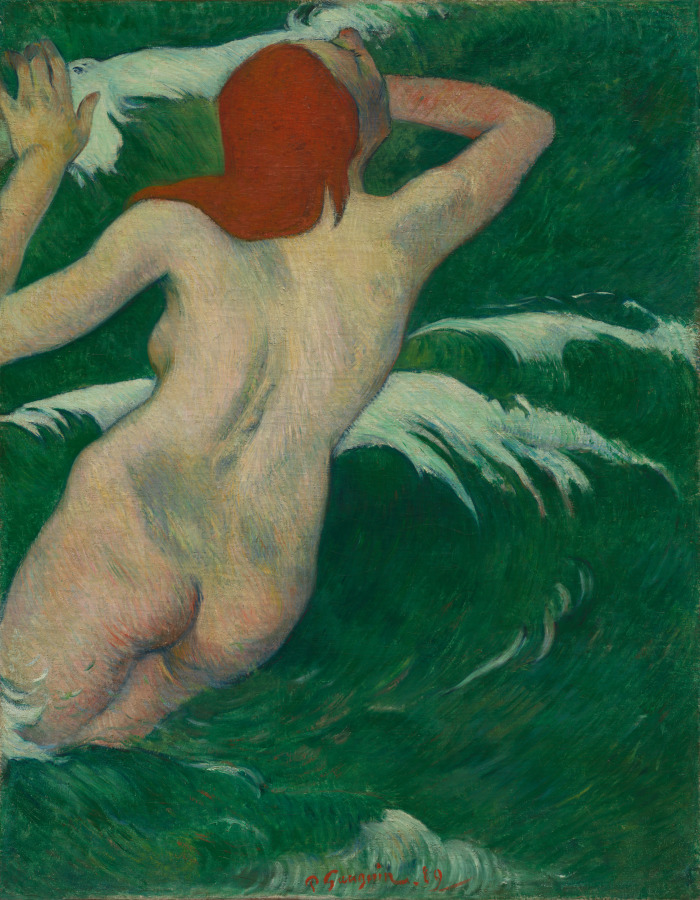
Painted at Pont-Aven in northwest France, this depiction of a nude figure throwing herself into the sea suggests a metaphor for a modern European woman forsaking civilization and abandoning herself to her natural, primitive instincts. The simplified lines and exaggerated colors, especially the contrasting green and orange, seem invented rather than observed from life. Exhibiting the painting at the Café Volpini in Paris in 1889, Gauguin established himself as a leader of the Symbolist movement in art.
Provenance
On consignment with Boussod & Valadon, Paris, FR. (1890); (Gauguin sale, Paris, FR, February 23, 1891, lot 14, to M. Jeanson) (1891); (Joseph Hessel, Paris, FR, March 1906, sold to Gustave Fayet) (1906); (Gustave Fayet [1865–1925], Paris, FR, February 1907, sold to Ambroise Vollard) (1906–1907); (Paul Éluard, Paris, FR, who probably bought it at Galerie Dru in 1923) (probably 1923); (Drouot, Paris, FR, December 12, 1927, lot 103, sold to Hessel) (1927); Leicester Galleries, London, UK. (1928); Purchased by Frank H. Ginn, Cleveland, OH (1929); Mr. and Mrs. Powell Jones, Gates Mills, OH, given to the Cleveland Museum of Art. (1978); The Cleveland Museum of Art, Cleveland, OH (1978–)
Accession Number
1978.63
Medium
oil on fabric
Dimensions
Framed: 123.8 x 106 x 7 cm (48 3/4 x 41 3/4 x 2 3/4 in.); Unframed: 92.5 x 72.4 cm (36 7/16 x 28 1/2 in.)
Classification
Painting
Credit Line
Gift of Mr. and Mrs. William Powell Jones