Description
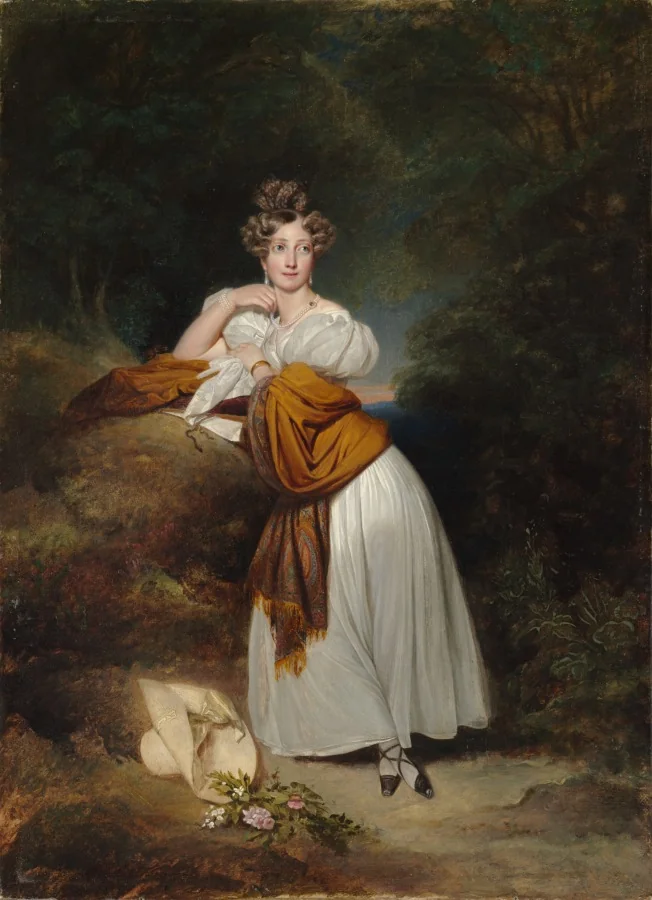
Sophie Guillemette (1801-1865), daughter of Gustavus IV Adolphus of Sweden, was the wife of Grand Duke Leopold of Baden. Winterhalter was her drawing instructor and made several portraits of both the duke and the duchess before leaving for London to become the most celebrated portrait painter of his time.
Provenance
Grand Dukes of Baden. London sale, Christie's, 24 November 1978 (lot 74, repr.), Property of a Lady: Portrait of Sophie Guillemette, Grand Duchess of Baden, £5.500, to Hazlitt, Gooden & Fox, Ltd., London. Purchased by the CMA in 1979.
Accession Number
1979.43
Medium
oil on fabric
Dimensions
Framed: 57.5 x 46.5 x 10 cm (22 5/8 x 18 5/16 x 3 15/16 in.); Unframed: 39.1 x 28.5 cm (15 3/8 x 11 1/4 in.)
Classification
Painting
Credit Line
The Thomas L. Fawick Memorial Collection
Tags
Painting Neoclassical & Romantic (1751–1850) Oil Painting German Color: Orange
Background & Context
Background Story
Franz Xaver Winterhalter (1805-1873) was a German painter known as the most sought-after portrait painter of European royalty in the 19th century, whose elegant, flattering portraits of queens and princesses made him the unofficial court painter of Europe. The portrait of Sophie Guillemette, Grand Duchess of Baden from 1831 depicts the sitter in the elegant, flattering manner that distinguishes Winterhalter's best court portraits from the more formal portraiture of his contemporaries. The 1831 date places this in Winterhalter's early career, before he had become the most sought-after portrait painter in Europe, but the portrait already shows the elegant manner that would make him famous.
Cultural Impact
Portrait of the Grand Duchess of Baden is important in the history of 19th-century portraiture because it demonstrates the elegant, flattering manner that would make Winterhalter the most sought-after portrait painter of European royalty. Winterhalter's court portraits—combining elegant composition with flattering rendition of the sitter—defined the visual image of European royalty for much of the 19th century, and the 1831 portrait shows the development of the manner that would make him the unofficial court painter of Europe.
Why It Matters
Portrait of the Grand Duchess of Baden is Winterhalter defining royal portraiture: the sitter rendered in the elegant, flattering manner that would make him the most sought-after portrait painter of European royalty. The 1831 portrait shows the developing manner that would define the visual image of European royalty for much of the 19th century.