Description
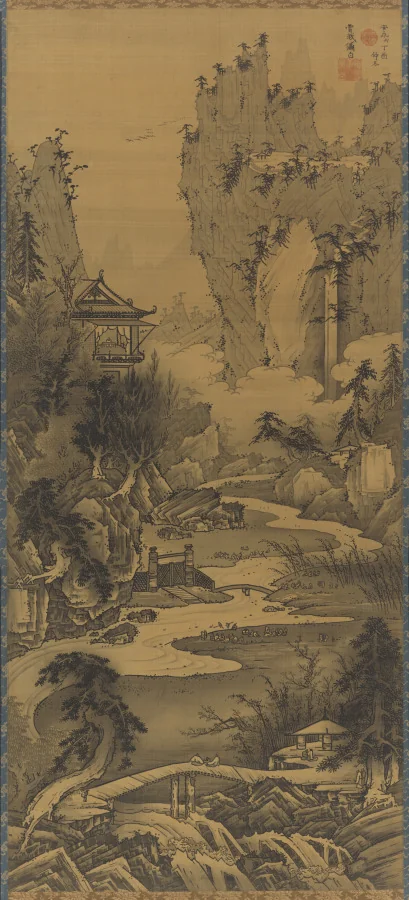
This painting depicts a famous gathering that took place in China in AD 353 to celebrate the Spring Purification Festival, also known as the Double Third Festival, as it takes place on the third day of the third lunar month. The host invited everyone to the Orchid Pavilion to compose poetry and drink wine. Guests floated wine cups down a nearby creek, and where they landed, people had to drink the wine and compose a poem.
Provenance
(Toyobi, sold to the Cleveland Museum of Art) (?–1979); The Cleveland Museum of Art, Cleveland, OH (1979–)
Accession Number
1979.53
Medium
hanging scroll; ink on silk
Dimensions
Painting: 122.7 x 55.7 cm (48 5/16 x 21 15/16 in.); Mounted: 197.4 x 58.8 cm (77 11/16 x 23 1/8 in.)
Classification
Painting
Credit Line
Purchase from the J. H. Wade Fund
Tags
Painting Neoclassical & Romantic (1751–1850) Ink Silk Painting Japanese Color: Orange Color: Gold Color: Brown
Background & Context
Background Story
Soga Shohaku (1730-1781) was a Japanese painter known for the bold, eccentric manner that makes him one of the most distinctive painters of the Edo period. Orchid Pavilion Gathering from 1777 depicts the famous literary subject of the Orchid Pavilion Gathering of 353 when the calligrapher Wang Xizhi gathered friends for a poetry party at the Orchid Pavilion in Shaoxing. Shohaku treated this classical Chinese subject in his characteristic bold, eccentric manner—combining the Chinese literary tradition with a distinctly Japanese boldness that is unlike any other Edo period painter. The 1777 date places this in Shohaku's mature period, when his bold, eccentric manner was at its most distinctive.
Cultural Impact
Orchid Pavilion Gathering is important in the history of Japanese painting because it demonstrates the bold, eccentric manner that makes Shohaku one of the most distinctive painters of the Edo period. Shohaku's treatment of the classical Chinese subject of the Orchid Pavilion Gathering in his bold, eccentric manner shows how a Japanese painter could transform a Chinese literary subject into a distinctly Japanese type of painting, and the 1777 painting shows this transformation at its most distinctive.
Why It Matters
Orchid Pavilion Gathering is Shohaku's bold Japanese transformation: the famous Chinese literary subject treated in the eccentric, bold manner that makes him the most distinctive painter of the Edo period. The 1777 painting shows the classical Chinese subject transformed into a distinctly Japanese type of painting that is unlike any other Edo period work.