Description
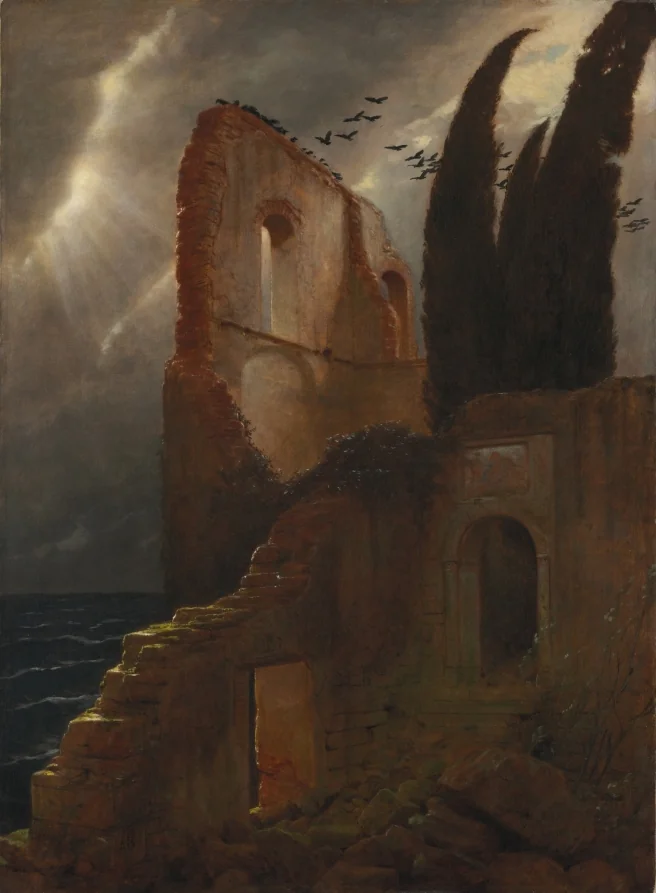
The dark, ruined villa in this painting is made especially mysterious by the strange cypress trees tossed by the wind. A nervous green light flickers through the scene. Influenced by German Romantic art of the early 1800s, Böcklin was preoccupied with dreamlike images suggestive of death.
Provenance
C. Wetter-Rüsch, St. Gallen, by 1893. Hermann Nabel, Berlin 1897. Kunsthandel Eduard Schulte, Berlin 1902. E. Junghanns, Schramberg. Paul Landenberger Jr., Schramberg. Zürich sale, Max G. Bollag, 23 March 1933 (lot 107), Ruine am Meer, reproduced. Private collection, Zürich. Fischer Fine Art, London. Purchased by the cma on 17 August 1979.
Accession Number
1979.57
Medium
oil on fabric
Dimensions
Framed: 132.1 x 102.9 x 8.3 cm (52 x 40 1/2 x 3 1/4 in.); Unframed: 111 x 82 cm (43 11/16 x 32 5/16 in.)
Classification
Painting
Credit Line
Mr. and Mrs. William H. Marlatt Fund
Tags
Painting Impressionist & Modern (1851–1900) Oil Painting Swiss Color: Orange
Background & Context
Background Story
Ruin by the Sea from 1881 is one of Böcklin's most atmospheric paintings, depicting a classical ruin on a rocky coast with the dark, mysterious atmosphere that defines his best work. The ruin—a fragment of classical civilization collapsing into the sea—is a memento mori that combines Böcklin's interest in classical antiquity with his fascination with decay and mortality. The 1881 date places this in the period when Böcklin was producing his most Symbolist works, and the ruin by the sea is one of the purest expressions of the mood of melancholy and mysterious foreboding that characterizes Symbolist painting at its most evocative.
Cultural Impact
Böcklin's Ruin by the Sea is one of the most influential paintings in the development of Symbolism because it defines the mood of melancholy and mysterious foreboding that Symbolist painters sought throughout Europe. The classical ruin-a fragment of civilization collapsing into the sea-combines Böcklin's classical training with his Symbolist imagination, creating a painting that influenced not only the visual arts but also the literature and music of the Symbolist movement.
Why It Matters
Ruin by the Sea is Böcklin's Symbolist mood at its most evocative: a classical ruin on a rocky coast combining memento mori with mysterious foreboding, a fragment of civilization collapsing into the sea. The 1881 painting defines the melancholy atmosphere that influenced Symbolist painters, writers, and composers throughout Europe.
![Saint Bernard and Saint Catherine of Alexandria with the Virgin of the Annunciation [right panel]](https://api.nga.gov/iiif/e6890364-4d99-4684-a62b-5060ee3c3446/full/400,/0/default.jpg)