Description
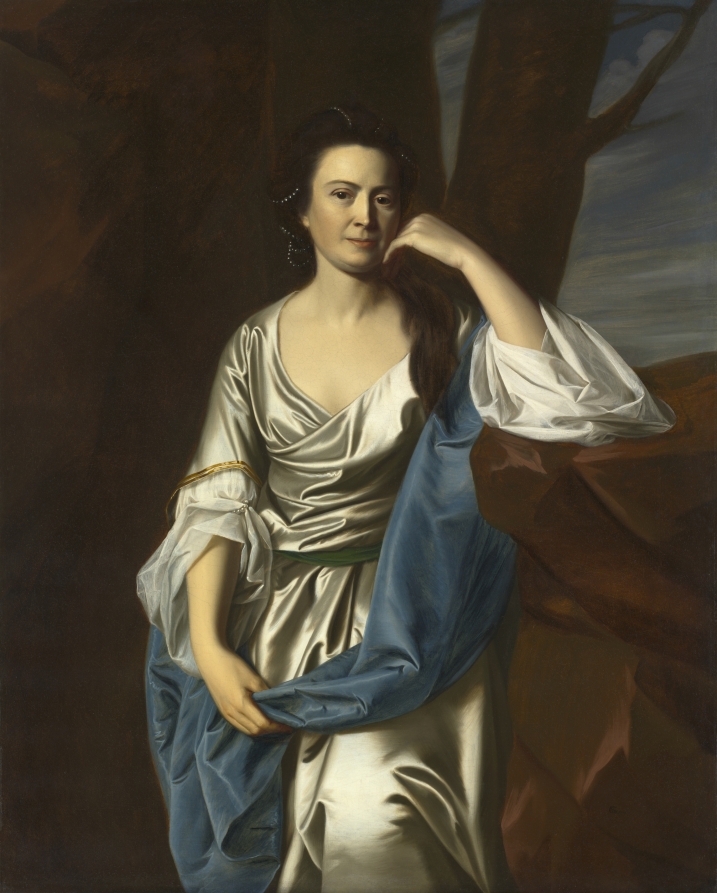
Less than two months before the 80-year-old Powell passed away, one of her sons commissioned this portrait in order to commemorate her life and create an heirloom for future generations. According to the sitter’s granddaughter, Powell was “a little woman of sober conviction and strong Presbyterian faith.” The painting passed through a line of female descendants until shortly before it was given to the museum.
Provenance
The Cleveland Museum of Art, Cleveland, Ohio (1980-); Ellery Sedgwick, Jr. [1908-1991], Cleveland, OH, to the Cleveland Museum of Art (By 1937-1980); Mabel Cabot Sedgwick [1873-1937], by descent to her son, Ellery Sedgwick, Jr. (By 1920-by 1937); Elizabeth Rogers Mason Cabot [1834-1920], by descent to her daughter, Mabel Cabot Sedgwick (-by 1920); Anna Powell Rogers? (By 1915); Mr. or Mrs. Henry Rogers, possibly by descent to Mrs. Rogers' sister, Elizabeth Cabot (By 1873); Anna Powell Perkins, Boston, by descent to her granddaughter, Mrs. Henry Rogers, or to Mr. Henry Rogers (By 1783)
Accession Number
1980.202
Medium
oil on canvas
Dimensions
Framed: 143.5 x 119 x 7 cm (56 1/2 x 46 7/8 x 2 3/4 in.); Unframed: 126.6 x 100.6 cm (49 13/16 x 39 5/8 in.)
Classification
Painting
Credit Line
Gift of Ellery Sedgwick Jr., in memory of Mabel Cabot Sedgwick
Tags
Painting Neoclassical & Romantic (1751–1850) Oil Painting Canvas American Color: Red Color: Brown
Background & Context
Background Story
Anna Dummer Powell from 1764 is a portrait from Copley's American period, depicting a member of the colonial elite with the direct observation and precise rendering of surfaces that distinguish his best colonial work. The 1764 date places this in the period when Copley was establishing himself as Boston's leading portrait painter, before the political tensions that would eventually force him to leave for London. Anna Dummer Powell's face is rendered with the same unflinching honesty that Copley brought to all his American portraits—neither flattering nor harsh, but observant to the point of clinical precision.
Cultural Impact
Copley's American portraits are among the most important documents of colonial society because they record the faces of the men and women who would become the leaders of the American Revolution with a directness that no other painter of the period could match. Anna Dummer Powell is a colonial woman rendered with the same honest observation that Copley brought to his portraits of merchants, politicians, and soldiers—neither idealized nor caricatured, but observed with the precision of a painter who had no academic conventions to fall back on and no choice but to paint what he saw.
Why It Matters
Anna Dummer Powell is Copley's American portraiture at its most direct: a colonial woman observed with the precision that distinguishes his pre-London work, before academic conventions softened his eye. The 1764 date places this in the heart of Copley's American period—a face recorded with the clinical honesty of a painter who painted what he saw, not what convention dictated.