Description
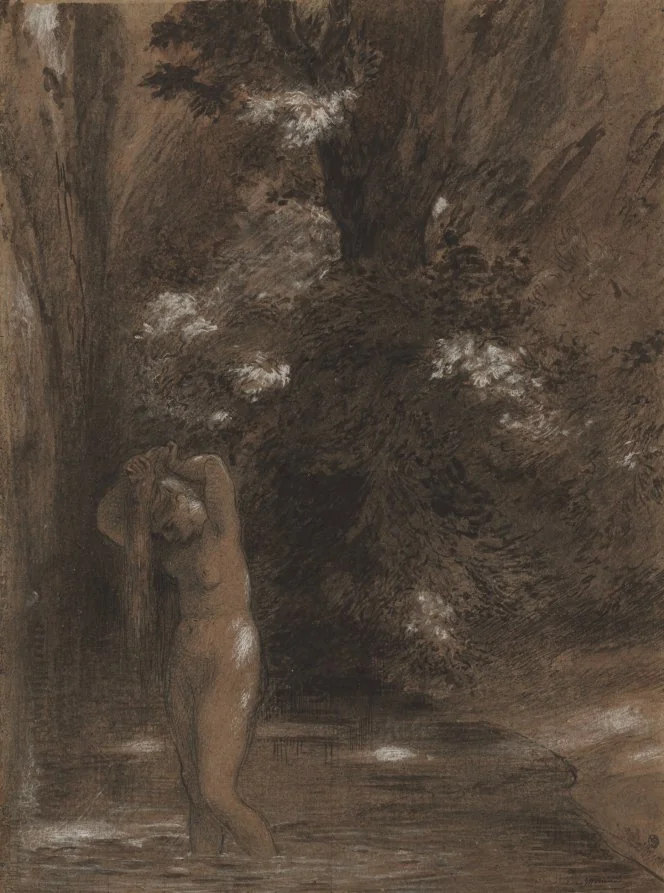
This drawing relates to Félix Bracquemond’s interest in integrating various artistic techniques, a practice that became increasingly common around 1900. With a range of black and white media, the artist depicted a nude in a forest pool. Faint gridding was used to transfer the image either to or from a similar enamel and a print. An important part of this working process, the drawing was included in both of the major exhibitions of Bracquemond’s oeuvre during his life. From one of these displays, in 1907, Bracquemond sold it to Parisian collector Alfred Beurdeley, who acquired hundreds of drawings with the aim of representing the art of his time.
Provenance
Alfred Beurdeley [1847-1919, Lugt 421], Paris (by 1907-1919); (his ninth sale, November 30 and December 2, 1920, no. 50, sold to Boutet) (1920); Boutet (1920-?); Noah Butkin [1918-1980], Shaker Heights, OH, bequeathed to the Cleveland Museum of Art, Cleveland, OH (by 1979-1980); Cleveland Museum of Art, Cleveland, OH (1980-)
Accession Number
1980.240
Medium
brush and black and brown wash with pen and black ink, black chalk, and charcoal, heightened with white chalk, on brown wove paper laid on yellow-beige wove paper
Dimensions
Sheet: 59 x 44 cm (23 1/4 x 17 5/16 in.)
Classification
Drawing
Credit Line
Bequest of Noah L. Butkin
Tags
Drawing Impressionist & Modern (1851–1900) Ink Charcoal Paper French Color: Brown
Background & Context
Background Story
Felix Bracquemond (1833-1914) was a French painter and printmaker known as one of the most important printmakers of the 19th century, whose etchings helped revive the art of original printmaking in France. The Bath from c. 1900 depicts a bather in the accomplished etching manner that distinguishes Bracquemond's best prints from the reproductive etching of his contemporaries. The c. 1900 date places this in Bracquemond's late period, when he was still producing accomplished etchings in the original manner that had helped revive the art of printmaking in France starting in the 1850s.
Cultural Impact
The Bath is important in the history of French printmaking because it demonstrates the original etching manner that Bracquemond helped to revive in 19th-century France. Bracquemond's original etchings—produced as original works of art rather than reproductions of paintings—helped to revive the art of original printmaking in France, and The Bath shows the accomplished etching manner that made him one of the most important printmakers of the 19th century even in his late period.
Why It Matters
The Bath is Bracquemond's accomplished etching: a bather rendered in the original manner that helped revive the art of original printmaking in 19th-century France. The c. 1900 etching shows the most important printmaker of the 19th century still producing accomplished original work in his late period.