Provenance
Paul Périer, Paris. His collection sale, Paris, 19 December 1846 (lot 2), Le bon Samaritain, 28 x 46 cm, ff 2,405. Galerie B. G. Verte, Paris, 1977. Mr. and Mrs. Noah L. Butkin, Cleveland. Bequeathed to the CMA in 1980.
Accession Number
1980.253
Medium
oil on fabric
Dimensions
Framed: 54 x 71 x 10 cm (21 1/4 x 27 15/16 x 3 15/16 in.); Unframed: 28.8 x 46 cm (11 5/16 x 18 1/8 in.)
Classification
Painting
Credit Line
Bequest of Noah L. Butkin
Tags
Painting Neoclassical & Romantic (1751–1850) Oil Painting French Color: Orange Color: Gold
Background & Context
Background Story
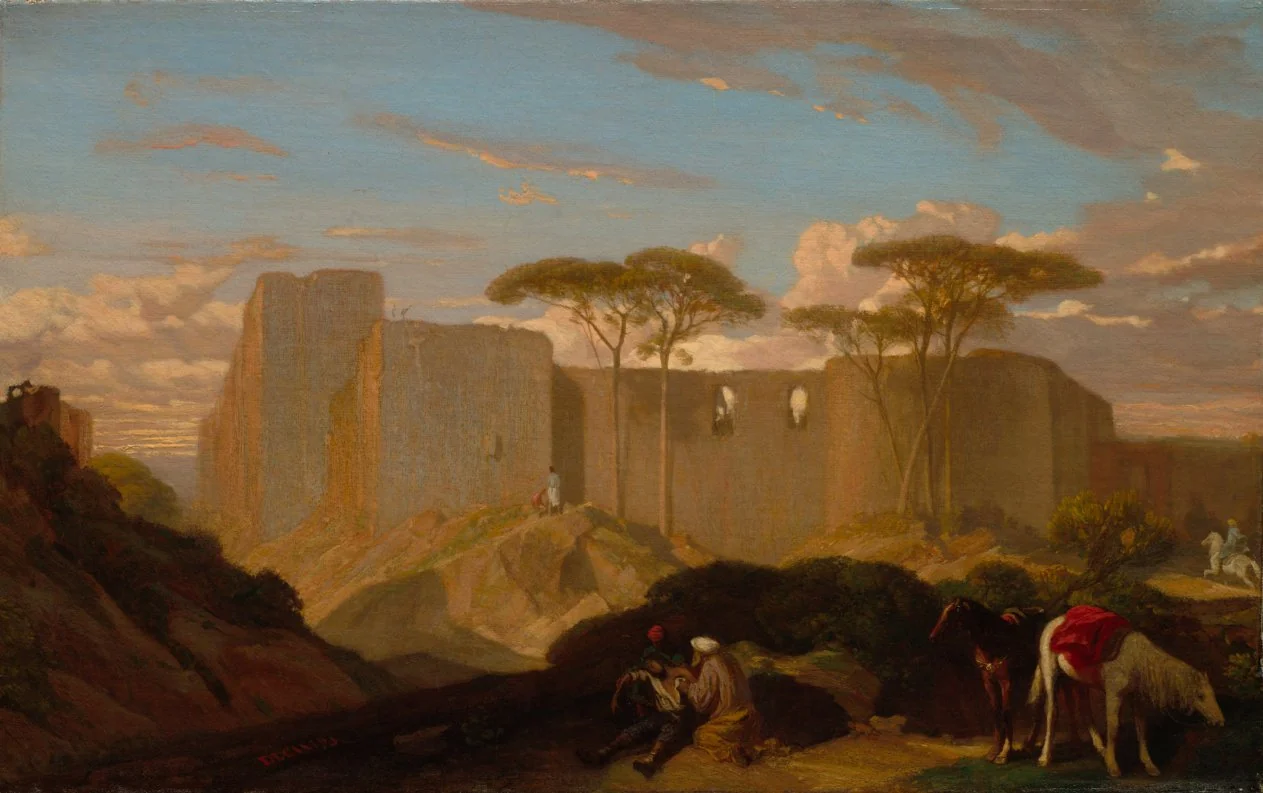
The Good Samaritan from c. 1842 is Decamps's treatment of the biblical parable, depicting the moment when the Samaritan helps the wounded traveler on the road from Jerusalem to Jericho. Decamps brings his characteristic realism to the biblical subject: the Samaritan and the wounded traveler are rendered with the physical specificity and atmospheric truth that distinguish his Orientalist scenes, and the landscape setting has the arid, rocky quality of the Holy Land rather than the lush pastoral of traditional biblical painting. The 1842 date places this in Decamps's most productive period, when he was applying the realism he had developed in Orientalist scenes to biblical subjects.
Cultural Impact
Decamps's Good Samaritan is important in the history of 19th-century biblical painting because it applies the realism of Orientalist painting to a biblical subject, replacing the idealized landscapes of traditional biblical art with the arid, rocky terrain of the actual Holy Land. The Samaritan and the traveler have the physical specificity of real people rather than the generalized features of biblical types, and the landscape has the atmospheric truth of a scene observed on site.
Why It Matters
The Good Samaritan is Decamps applying Orientalist realism to a biblical subject: the arid Holy Land landscape replacing the lush pastoral of traditional biblical painting, and the Samaritan and traveler rendered with the physical specificity of real people rather than biblical types. The 1842 painting demonstrates that Decamps's realism was as effective for biblical subjects as for Orientalist ones.