Description
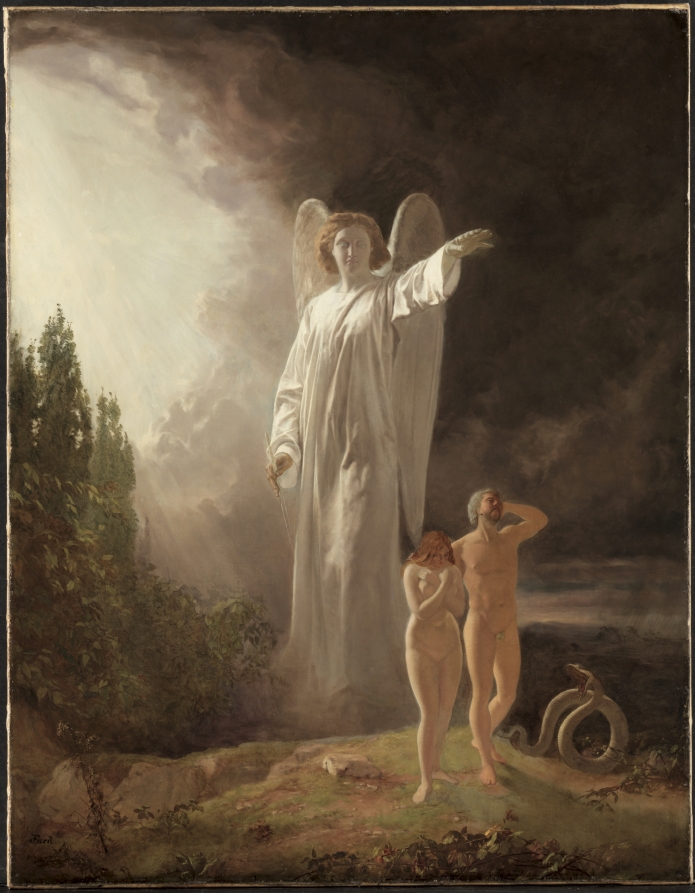
John Milton's epic poem Paradise Lost (1667) was the principal literary source for John Faed's depiction of the expulsion of Adam and Eve. The archangel Michael directs the couple away from the lush gardens and heavenly radiance of Eden, while Satan in the form of a snake appears in the right foreground. In most representations of the subject, Michael guards the gates of Paradise with a fiery sword, as prescribed in both Genesis and Paradise Lost. Faed, on the other hand, has him brandishing a compass, an instrument traditionally employed by God the Father in his act of creating the world.
Provenance
Private collector, consigned to Sotheby’s (Until 1967); (Sale, Sotheby’s, London, Jan. 11, 1967, lot 6, sold to the Fine Art Society, Ltd.) (1967); (Fine Art Society, Ltd., London, sold to R. John Rickett) (1967); R. John Rickett [1930-1970], London, to his wife, Mrs. John Rickett (1967-1970); Mrs. John Rickett, consigned to Sotheby’s Belgravia (1970-1975); (Sale, Sotheby's Belgravia, London, Nov. 11, 1975, lot 87) (1975); (Barry Friedman, Ltd., New York, sold to Shepherd Gallery) (c. 1975-1976); (Shepherd Gallery, New York, sold to Noah L. and Muriel S. Butkin) (Until February 1977); Noah L. and Muriel S. Butkin, Cleveland, OH, bequeathed to the Cleveland Museum of Art as a result of disclaimer by Muriel S. Butkin (1977-1980); The Cleveland Museum of Art, Cleveland, Ohio (1980-)
Accession Number
1980.258
Medium
oil on fabric
Dimensions
Unframed: 91.3 x 70.7 cm (35 15/16 x 27 13/16 in.)
Classification
Painting
Credit Line
Bequest of Noah L. Butkin
![Saint Bernard and Saint Catherine of Alexandria with the Virgin of the Annunciation [right panel]](https://api.nga.gov/iiif/e6890364-4d99-4684-a62b-5060ee3c3446/full/400,/0/default.jpg)