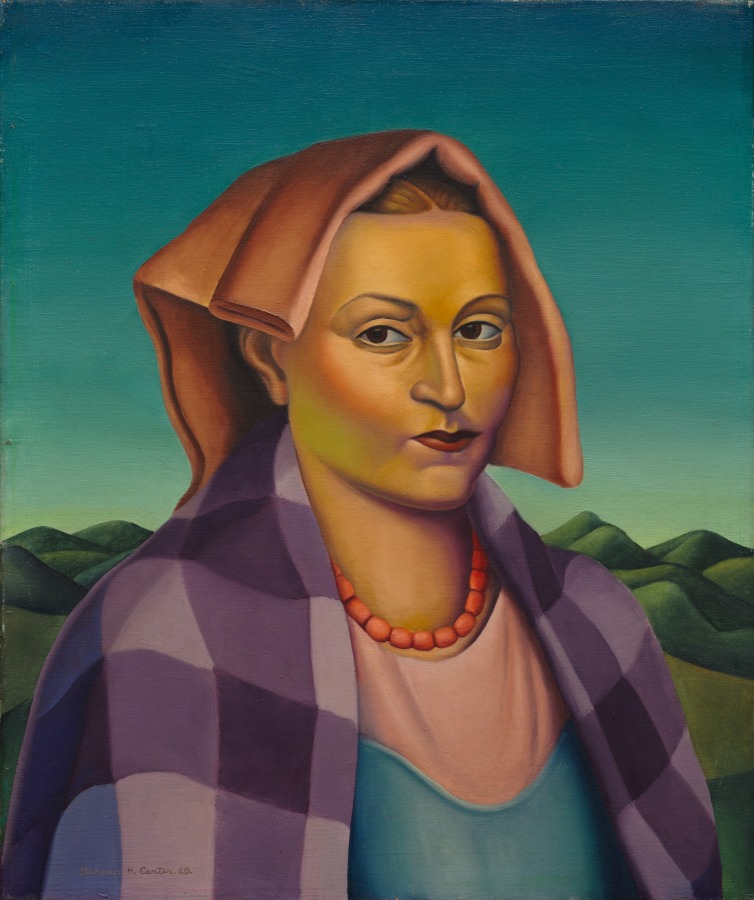
Accession Number
1980.302
Medium
oil on canvas
Dimensions
Framed: 75.9 x 101.6 x 2.5 cm (29 7/8 x 40 x 1 in.); Unframed: 66 x 91.4 cm (26 x 36 in.)
Classification
Painting
Credit Line
Gift of Lillian M. Kern
Tags
Painting Early Modern (1901–1950) Oil Painting Canvas American Color: Orange Color: Brown Color: Gray
Background & Context
Background Story
Circus Horses from 1933 is an example of Carter's realistic work that still shows the quality of strangeness that would later develop into full-blown Surrealism. The circus subject allows Carter to depict horses in an artificial setting that hints at the Surrealist quality of his later work, while still maintaining the precise observation that distinguishes his rural subjects. The 1933 date places this in the transitional period between Carter's early realistic work and his later metaphysical paintings, and the circus subject—with its combination of precise observation and inherent theatricality—anticipates the direction his art would take.
Cultural Impact
Circus Horses is important in Carter's development because it shows the transitional moment between his early realistic work and his later Surrealist-influenced metaphysical paintings. The circus subject—precisely observed but inherently theatrical—anticipates the direction Carter's art would take, demonstrating that the Surrealist quality of his later work was already present in embryo in his realistic subjects.
Why It Matters
Circus Horses is Carter in transition: the precisely observed but inherently theatrical circus subject that anticipates the Surrealist evolution of his later career. The 1933 oil on canvas shows the quality of strangeness emerging from realistic observation that would become the foundation of Carter's metaphysical paintings.