Description
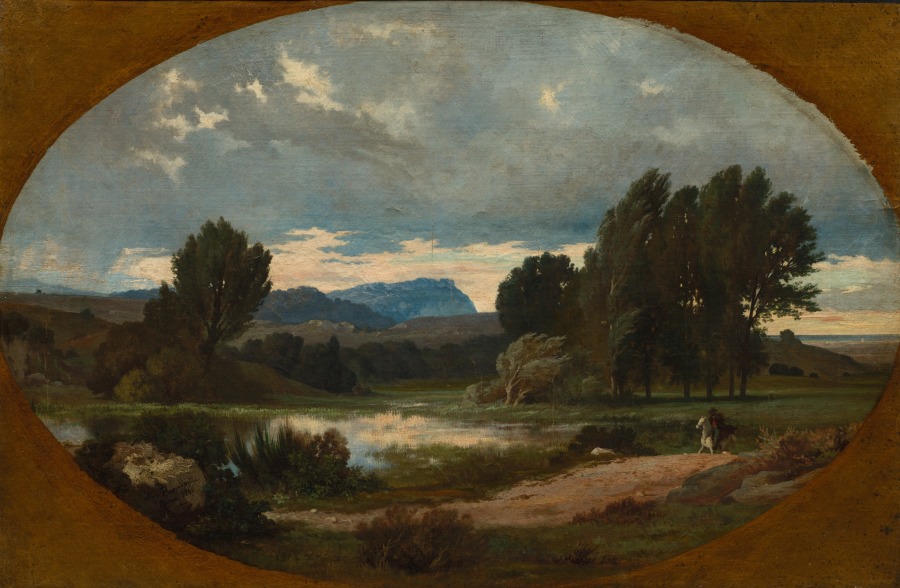
Located in the Mediterrean Sea, south of Rome, the island of Capri has been famous since Roman times for its spectacular scenery and mild climate. In the 19th century it became the home of many European nobles, and attracted artists from across the continent. Here Benouville captured the beauty of the island's rocky coastline, focusing his attention on a path leading toward the city of Capri and past the rocky outcropping of Monte Solaro. Fascinated by the Italian landscape, Benouville spent years in Italy drawing and painting the countryside. From 1838 to 1845 he made at least three trips there, and in 1845, after winning the Prix de Rome—a fellowship allowing promising artists to study in that city—he spent much of the next 25 years in Italy. Although trained to paint landscapes in a very formal manner, after leaving France Benouville began to paint his subjects with a much more personal, nontraditional approach. This may account for this picture's unusual composition, in which much of the canvas is given to indistinct but beautifully painted stone, sky, and water.
Provenance
Hazlitt, Gooden & Fox, London, 1979. Purchased by the CMA on 30 January 1980.
Accession Number
1980.5
Medium
oil on fabric
Dimensions
Framed: 43 x 60 x 6 cm (16 15/16 x 23 5/8 x 2 3/8 in.); Unframed: 28.1 x 44.7 cm (11 1/16 x 17 5/8 in.)
Classification
Painting
Credit Line
Mr. and Mrs. William H. Marlatt Fund
Tags
Painting Neoclassical & Romantic (1751–1850) Oil Painting French Color: Brown Color: Gray
Background & Context
Background Story
Jean Achille Benouville (1815-1871) was a French painter known for the atmospheric, precisely observed landscape paintings of Italian subjects that make him one of the most accomplished landscape painters of the French tradition. Capri from c. 1845 depicts the island of Capri in the atmospheric, precisely observed manner that distinguishes Benouville's best work from the more general landscape painting of his contemporaries. Benouville was known for his atmospheric, precisely observed landscapes of Italian subjects—particularly the island of Capri and the Roman Campagna—and the c. 1845 painting shows the Italian landscape at its most atmospheric and precisely observed.
Cultural Impact
Capri is important in the history of French landscape painting because it demonstrates the atmospheric, precisely observed manner that Benouville brought to Italian subjects as one of the most accomplished landscape painters of the French tradition. Benouville's atmospheric, precisely observed landscapes of Italian subjects—particularly Capri and the Roman Campagna—represent one of the most accomplished traditions in French landscape painting of Italian subjects, and the c. 1845 painting shows this tradition at its most atmospheric.
Why It Matters
Capri is Benouville's atmospheric Italian landscape: the island of Capri rendered in the precisely observed manner of one of the most accomplished landscape painters of the French tradition. The c. 1845 painting shows the atmospheric effect and precise observation that make Benouville's Italian landscapes distinctive.