Provenance
(Shogoro Yabumoto, Amagasaki, Hyōgo Prefecture, Japan, sold to the Cleveland Museum of Art) (?–1982); The Cleveland Museum of Art, Cleveland, OH (1982–)
Accession Number
1982.54
Medium
hanging scroll; ink on paper
Dimensions
Image: 185.5 x 102.5 cm (73 1/16 x 40 3/8 in.); Mounted: 257.7 x 123.8 cm (101 7/16 x 48 3/4 in.)
Classification
Painting
Credit Line
Mr. and Mrs. William H. Marlatt Fund
Tags
Painting Neoclassical & Romantic (1751–1850) Ink Paper Chinese Color: Gray
Background & Context
Background Story
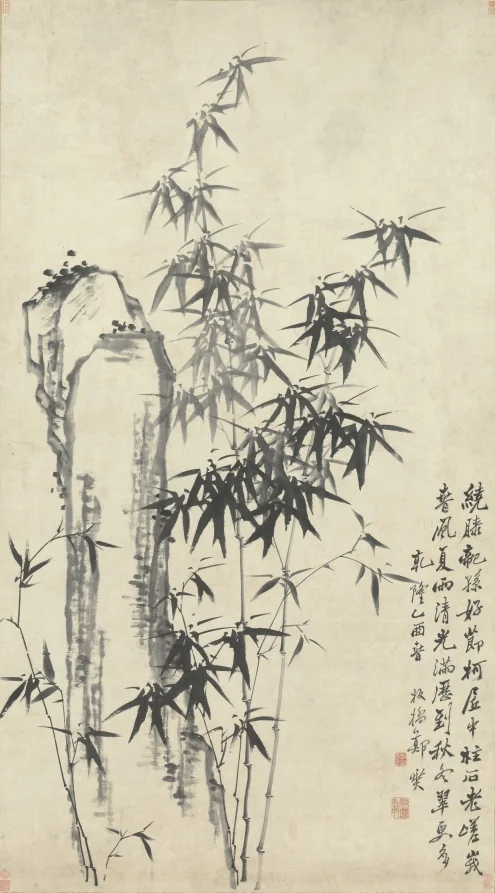
Zheng Xie (1693-1765), known as Zheng Banqiao, was a Chinese painter, calligrapher, and poet known as one of the Eight Eccentrics of Yangzhou, whose bamboo and orchid paintings in the expressive, individualistic manner of the literati tradition make him one of the most distinctive painters of the Qing dynasty. Bamboo and Rock from 1765, the year of Zheng Xie's death, depicts bamboo and rock in the expressive, calligraphic manner that distinguishes his best work from the more orthodox painting of his contemporaries. The 1765 date makes this one of Zheng Xie's last paintings, and the bamboo subject combined with the rock shows the literati tradition at its most expressive and individualistic.
Cultural Impact
Bamboo and Rock is important in the history of Chinese painting because it demonstrates the expressive, individualistic manner that makes Zheng Xie one of the Eight Eccentrics of Yangzhou. Zheng Xie's bamboo paintings—combining expressive brushwork with the literati ideal of painting for self-cultivation—represent the individualistic tradition in Chinese painting that rejected academic orthodoxy in favor of personal expression, and the 1765 painting shows this individualistic tradition in one of its last and most accomplished expressions.
Why It Matters
Bamboo and Rock is Zheng Banqiao's final statement: bamboo and rock rendered in the expressive, calligraphic manner of one of the Eight Eccentrics of Yangzhou, painted in the year of his death. The 1765 painting shows the literati tradition at its most individualistic—the personal expression that rejected academic orthodoxy in favor of calligraphic brushwork and spiritual meaning.