Provenance
William Russell, London; [sale, Christie's, London, 10-12 Dec. 1884, lot 403] (1884 ); John Charles Robinson, London; John Postle Heseltine, London; [P. and D. Colnaghi, London]; Private Collection, France; Private Collection, New York; [Eugene Victor Thaw, New York] (1983 ); all according to Cleveland/Cambridge/Ottawa 1989, p. 47: William Russell, London (Lugt 2648, stamped twice, lower right, blindstamp); [his sale, Christie's, London, 10-12 Dec. 1884, lot 403]. John Charles Robinson, London (Lugt 1433, lower right, in brown ink). John Postle Heseltine, London (Lugt 1507, not stamped). [P. and D. Colnaghi, London]. Private Collection, France. Private Collection, New York. [Eugene Victor Thaw, New York]
Accession Number
1983.197
Medium
pen and brown ink and brush and brown wash
Dimensions
Sheet: 12.6 x 22 cm (4 15/16 x 8 11/16 in.)
Classification
Drawing
Credit Line
Leonard C. Hanna Jr. Fund
Tags
Color: Orange Color: White
Background & Context
Background Story
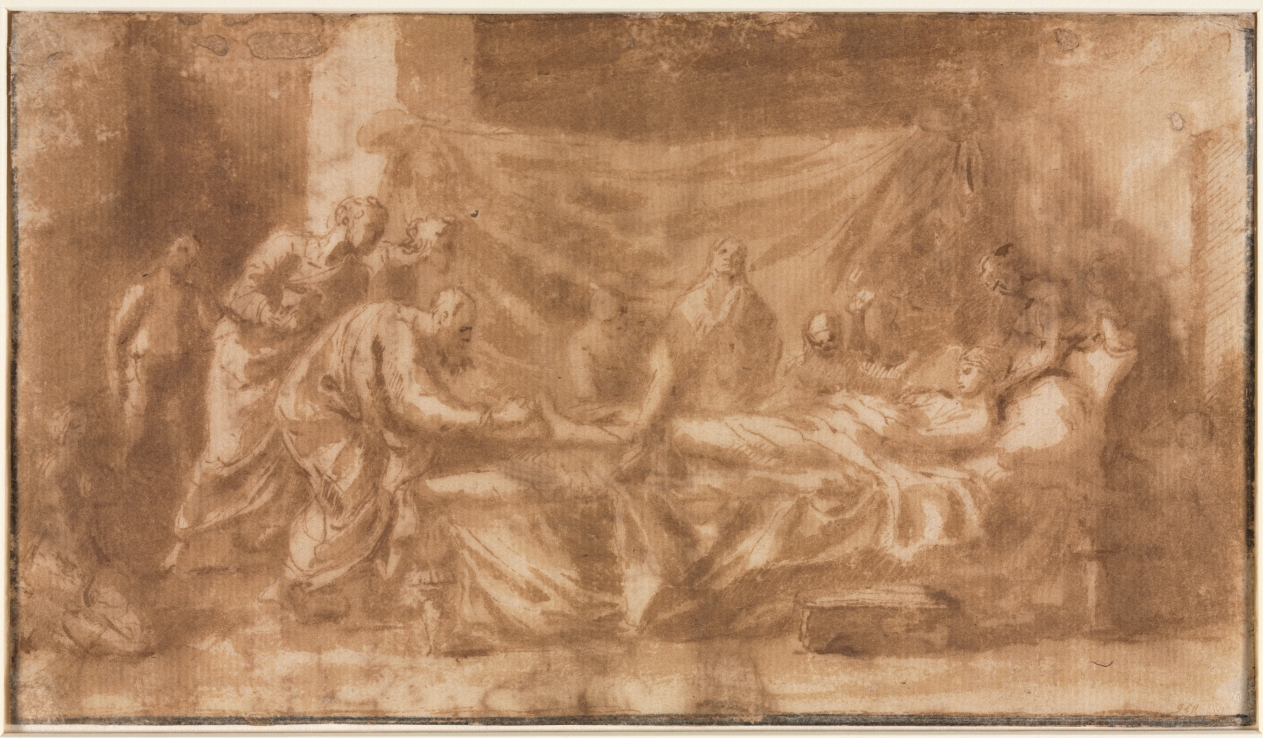
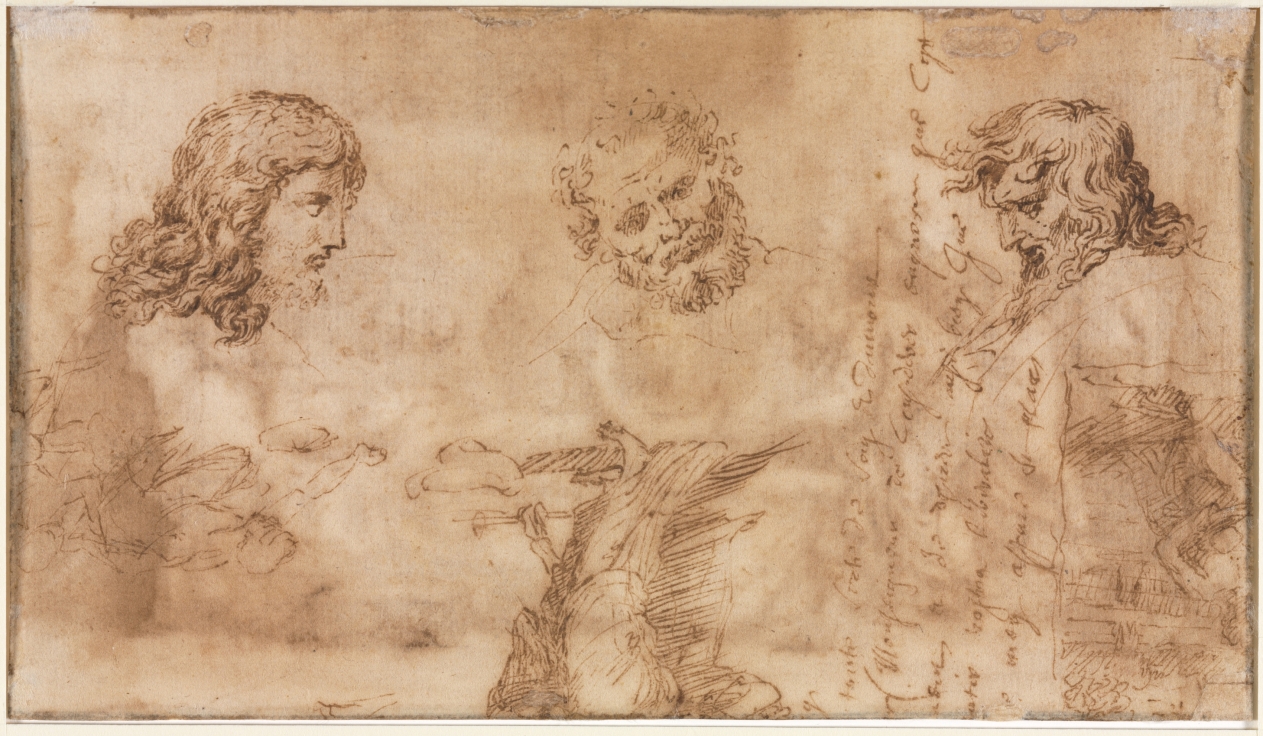
Nicolas Poussin (1594–1665), the greatest French painter of the 17th century and a central figure of European classicism, created this double-sided drawing between 1643 and 1644. The recto depicts the extreme unction—the last rites administered to the dying—a subject Poussin treated in one of his most celebrated painting series, "The Seven Sacraments." The verso features studies of three heads and other sketches, revealing the artist's working process. This drawing offers an intimate glimpse into Poussin's method of composing narratives through careful figure studies and compositional refinement.
The recto composition, executed in pen and brown ink with brush and brown wash, shows the dying man on his bed surrounded by clergy and mourners. The figures are arranged with Poussin's characteristic clarity and geometric order—the bed at a slight diagonal, the attendants forming a frieze-like sequence, the space measured and rational. The wash creates subtle tonal gradations that suggest both the dim interior of the sickroom and the gravity of the sacramental moment.
Poussin painted two versions of "The Seven Sacraments," one for Cassiano dal Pozzo (1630s) and a second for Paul Fréart de Chantelou (1640s), both now in prestigious collections. This drawing relates to the second series. The verso studies show Poussin working out facial expressions and poses—each head a different emotional register, from grief to compassion to solemn duty. These rapid sketches, dashed off in moments of concentrated thought, reveal the analytical mind behind Poussin's seemingly effortless classicism. For Poussin, every gesture and expression had to be legible within the painting's rational structure—a principle that made him the model for academic painting in France for two centuries.
Cultural Impact
Poussin's classicism established the standards for French academic painting from the 17th through the 19th centuries. Artists from Jacques-Louis David to Paul Cézanne measured themselves against Poussin's example. His sacramental paintings represent the culmination of his belief that painting should appeal to the mind through ordered, legible compositions.
Why It Matters
This double-sided drawing is a workshop document of extraordinary value, showing both Poussin's finished compositional thinking and the rapid exploratory studies that underlay it. It reveals the intellectual discipline behind the seemingly effortless harmony of Poussin's art.