Description
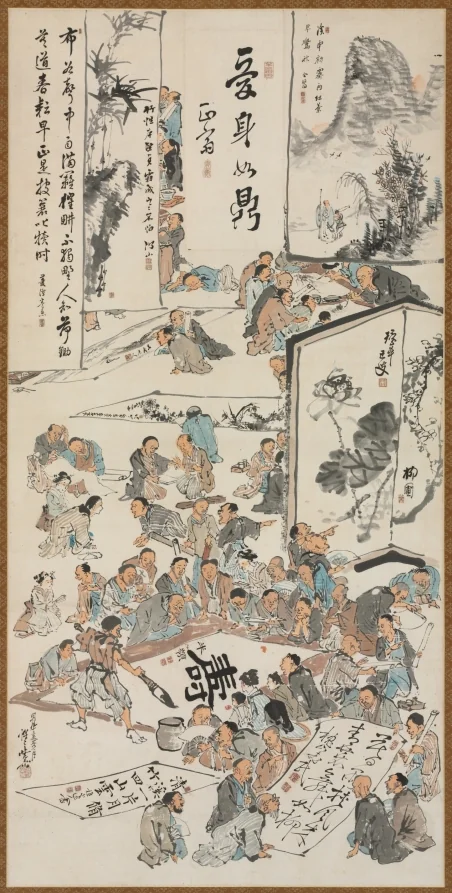
This lively painting depicts shogakai, a gathering during which calligraphers and painters created artwork in response to their patrons’ requests. Such calligraphy and painting parties were a popular topic to render in the early Meiji period. This work conveys the cheerful atmosphere of the gathering. Here, each tiny painting and calligraphy was made by an individual artist with his own seal and signature.
Provenance
(David Newman, New York, sold to the Cleveland Museum of Art) (?–1983); The Cleveland Museum of Art, Cleveland, OH (1983–)
Accession Number
1983.88
Medium
hanging scroll; ink and color on paper
Dimensions
Painting only: 139 x 69 cm (54 3/4 x 27 3/16 in.); Including mounting: 221 x 97.5 cm (87 x 38 3/8 in.)
Classification
Painting
Credit Line
Purchase from the J. H. Wade Fund
Tags
Painting Impressionist & Modern (1851–1900) Ink Paper Japanese Color: Gray
Background & Context
Background Story
Kawanabe Kyosai (1831-1889) was a Japanese painter known for the humorous, eccentric manner that makes him one of the most distinctive painters of the Meiji era. Painting Party from 1880 depicts a group of artists at a painting party in the humorous, energetic manner that distinguishes Kyosai's best work from the more formal painting of his contemporaries. The 1880 date places this in Kyosai's most productive Meiji period, when he was producing the humorous, eccentric paintings that are his most accomplished works, and the painting party subject allows him to exercise his talent for depicting the creative process with humor and energy.
Cultural Impact
Painting Party is important in the history of Japanese painting because it demonstrates the humorous, eccentric manner that makes Kyosai one of the most distinctive painters of the Meiji era. Kyosai's humorous paintings—combining the literati painting tradition with popular humor and eccentric energy—represent an alternative to the more formal painting of the Meiji period, and the 1880 painting shows this alternative at its most characteristic.
Why It Matters
Painting Party is Kyosai's humorous Meiji painting: a group of artists at a painting party rendered in the eccentric, energetic manner that makes him one of the most distinctive painters of the Meiji era. The 1880 painting combines the literati tradition with popular humor and eccentric energy—an alternative to the formal painting of the Meiji period.