Description
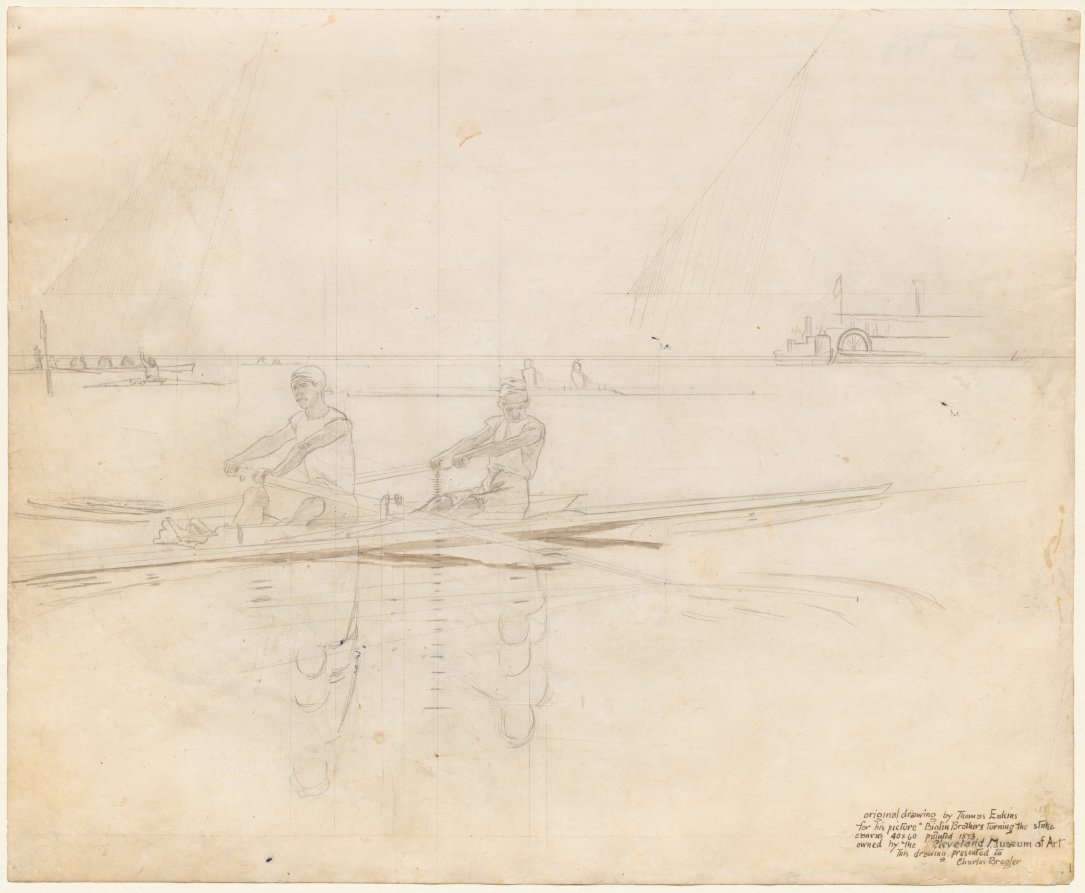
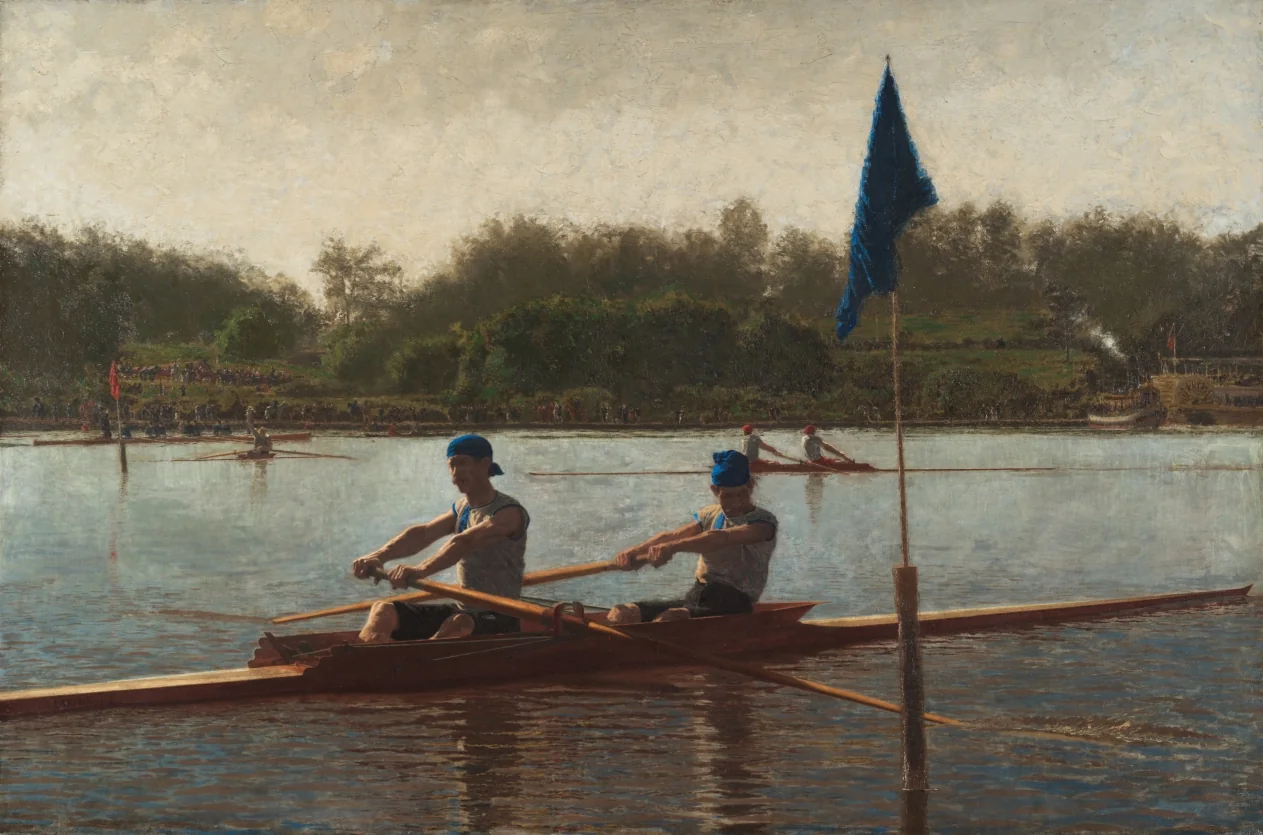
Eakins's painting celebrates athletic teamwork while commemorating an actual event, a famous rowing race that took place on the Schuylkill River in Philadelphia during May 1872. Throngs of spectators line the riverbank and watch as Barney and John Biglin negotiate the tricky turn around a stake marking the halfway point in the contest. Their competitors, seen in the middle distance at the right, lag behind. The Biglin brothers won the race, cementing their status as the most celebrated oarsmen of the era. Trained in the United States and France, Eakins spent almost his entire artistic career in his hometown of Philadelphia. He is renowned for the unsentimental realism in his paintings, whose compositions he developed through painstakingly prepared figure and perspective drawings.
Provenance
Susan MacDowell Eakins [1851-1938], Philadelphia, sold to the Cleveland Museum of Art (1916-1927); The Cleveland Museum of Art, Cleveland, OH (1927-)
Accession Number
1927.1984
Medium
oil on canvas
Dimensions
Framed: 117 x 167 x 6.5 cm (46 1/16 x 65 3/4 x 2 9/16 in.); Unframed: 101.3 x 151.4 cm (39 7/8 x 59 5/8 in.)
Classification
Painting
Credit Line
Hinman B. Hurlbut Collection
Tags
Painting Impressionist & Modern (1851–1900) Oil Painting Canvas American Color: Brown Color: White
Background & Context
Background Story
The Biglin Brothers Turning the Stake (1873) is the companion to Eakins's more famous Biglin Brothers Racing, depicting the crucial moment in a rowing race when the boat must turn around the stake marking the course's halfway point and return. This turning maneuver—requiring the sculler to simultaneously slow, turn, and accelerate—was the race's most technically demanding and visually dramatic moment. Eakins, who understood rowing from the inside, chose to depict this instant precisely because it revealed the sport's mechanical and physical demands most clearly. The composition's diagonal emphasis—the boat at an angle to the water, the oar cutting a turning arc, the water disturbed by the maneuver—creates visual energy that rivals the racing painting while adding the complexity of deceleration and redirection. The 1873 date places this as a sequel to the 1872 racing scene, painted when the Biglin brothers were still competing and the subject was still current. Eakins's approach to the turning stake reveals his deepest artistic conviction: that understanding a subject's mechanics—whether anatomical, athletic, or physical—enables rather than limits artistic expression. He paints the turn with the precision of a technical manual and the beauty of a symphony, proving that these are not competing goals.
Cultural Impact
The Turning the Stake painting influenced how athletic technical difficulty was represented in art, establishing that the most challenging moment of a sport could be the most visually rewarding subject. The painting influenced rowing instruction—Eakins's precise rendering of the turning technique was studied by competitive rowers—and influenced how sequence and series painting could explore a subject's temporal dimensions. The two Biglin paintings together demonstrated that a single athletic event could generate multiple complete artistic statements.
Why It Matters
This painting matters because it demonstrates the value of serial exploration—the same subject yielding different insights when approached from different temporal moments. Together with the racing painting, it establishes that an artist's deep knowledge of a subject generates, not repetition, but variety. For contemporary artists, the paired Biglin paintings offer a model for how sustained engagement with a subject enriches rather than exhausts artistic possibilities.