Description
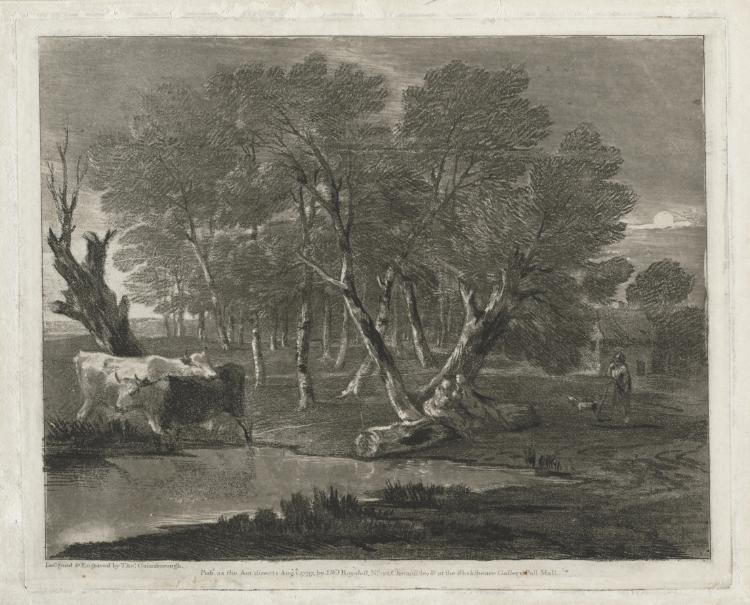
In a sketchy manner, Gainsborough convincingly singled out the various elements comprising this sweeping landscape—meadow, rocks, trees—by only slightly varying colors and brushstrokes. At the same time, however, a great sense of unity prevails. Although the bulk of Gainsborough's artistic output was portraits, he insisted that landscape was his first love.
Provenance
F. Fleischmann (1904), sold to O. Ashscroft (1904); O. Ashscroft, Birmingham, United Kingdom (1904); (Colnaghi, London, United Kingdom, sold to the Cleveland Museum of Art) (?-1984); The Cleveland Museum of Art, Cleveland, OH (1984-)
Accession Number
1984.59
Medium
oil on canvas
Dimensions
Framed: 89.5 x 110 x 8 cm (35 1/4 x 43 5/16 x 3 1/8 in.); Unframed: 70.5 x 91 cm (27 3/4 x 35 13/16 in.)
Classification
Painting
Credit Line
Mr. and Mrs. William H. Marlatt Fund
Tags
Painting Neoclassical & Romantic (1751–1850) Oil Painting Canvas British Color: Brown Color: Gray
Background & Context
Background Story
This imaginary landscape from Gainsborough's late period combines several of his favorite motifs: rocky terrain, dense woodland, a waterfall or weir, and rustic figures on a winding path. The composition descends from a dark, rocky overhang into a sunlit clearing where water tumbles over rocks — the kind of dramatic tonal contrast that Gainsborough loved and that Dutch 17th-century painters had perfected before him. But where a Dutch painter would have described each rock and tree with topographic precision, Gainsborough suggests them with feathery, almost abstract brushwork that dissolves form into atmosphere.
Cultural Impact
Gainsborough's late landscapes are among the most forward-looking paintings of the 18th century. The combination of naturalistic subject matter with increasingly abstract handling predicts not just Constable and Turner but the entire trajectory of landscape painting toward Impressionism. His willingness to sacrifice detail for atmosphere and surface beauty for emotional truth makes him the earliest painter who feels genuinely modern.
Why It Matters
Rocky, Wooded Landscape demonstrates that Gainsborough's imaginary scenes were not escapist fantasies but laboratories for landscape innovation. Every late Gainsborough landscape is an experiment in how much reality can be dissolved before painting becomes pure emotion.