Description
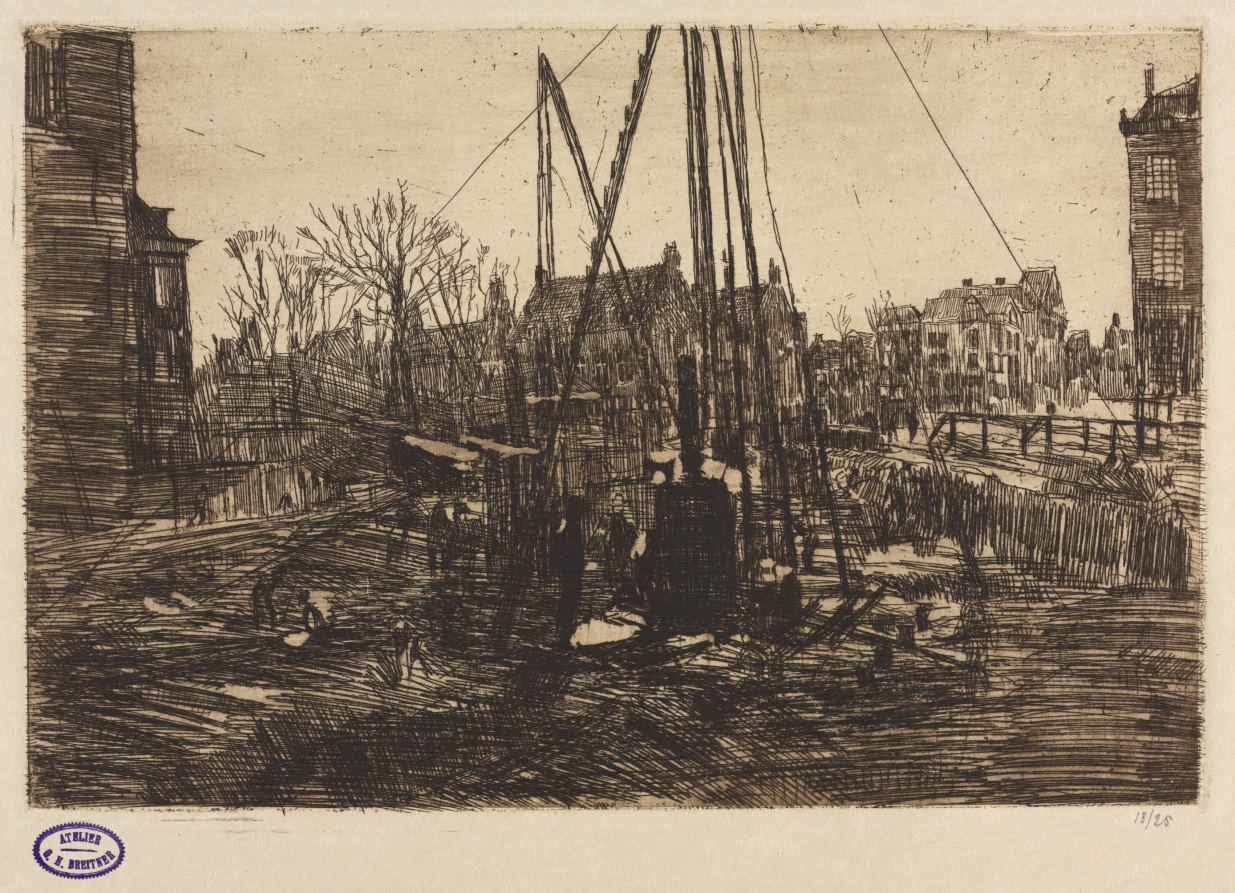
A leader of the Dutch Impressionists, Breitner based this painting on a series of photographs he took of a construction site in Amsterdam. Although seemingly executed rapidly on site, the painting was in fact carefully composed in the studio. Aided by his own photographs and sketches, Breitner portrayed a city in transition. Like his friend Vincent van Gogh, Breitner admired naturalist literature and was determined to become a “painter of the people.”
Provenance
E. J. van Wisselingh & Co., Amsterdam in 1902. Sold to A. Prins, Amsterdam/Hamburg, 31 May 1902, for Dfl 2.000. (Arij Prins [1860-1922] was a Dutch man of letters and a close friend of Breitner with whom he corresponded, and who lived in Hamburg from 1885 to 1905. Breitner's account book, which is in the Breitner Archive at the rkd in The Hague, lists the name of Arij Prins as the purchaser of the painting for Fl. 2.000. There is also a list of his works sold through the dealer van Wisselingh; there W. Prins, Hamburg, is mentioned as the purchaser of this work. W. is most likely a brother of Arij.) A. Terwindt. M. P. Voûte, Amsterdam, by 1922. Dr. W. L. Ladenius, Haarlem. Amsterdam sale, F. Muller & Co., 15-22 December 1942 (lot 129), Doorbraak Raadhuisstraat in den Winter, signed, canvas, 60.5 x 81 cm, repr., for Dfl 2.200. Amsterdam sale, Sotheby Mak van Waay, 15 May 1984 (lot 175), repr., for Dfl 47.560, to E. J. van Wisselingh & Co., Amsterdam. Purchased by the CMA in 1985.
Accession Number
1985.145
Medium
oil on fabric
Dimensions
Framed: 80 x 100 x 8.6 cm (31 1/2 x 39 3/8 x 3 3/8 in.); Unframed: 60.5 x 80.7 cm (23 13/16 x 31 3/4 in.)
Classification
Painting
Credit Line
Mr. and Mrs. William H. Marlatt Fund
Tags
Painting Impressionist & Modern (1851–1900) Oil Painting Dutch Color: Brown
Background & Context
Background Story
George Hendrik Breitner (1857-1923) was a Dutch painter known for the dynamic, atmospheric paintings of Amsterdam street life that make him one of the most important painters of the Amsterdam Impressionism movement. Construction Site in Amsterdam from c. 1902 depicts a construction site in Amsterdam in the dynamic, atmospheric manner that distinguishes Breitner's best city scenes from the more atmospheric painting of the Hague School. The c. 1902 date places this in Breitner's most productive period, when he was producing the dynamic, atmospheric paintings of Amsterdam street life that are his most accomplished works.
Cultural Impact
Construction Site in Amsterdam is important in the history of Dutch painting because it demonstrates the dynamic, atmospheric manner that Breitner brought to city scenes as the most important painter of the Amsterdam Impressionism movement. Breitner's dynamic city scenes—combining atmospheric observation with the dynamic energy of the modern city—represent an alternative to the more atmospheric, quiet landscape of the Hague School, and the c. 1902 painting shows this alternative at its most dynamic.
Why It Matters
Construction Site in Amsterdam is Breitner's dynamic city life: a construction site rendered in the atmospheric, energetic manner that makes him the most important painter of Amsterdam Impressionism. The c. 1902 painting shows the modern city as a dynamic, atmospheric subject—an alternative to the quiet landscape of the Hague School.