Description
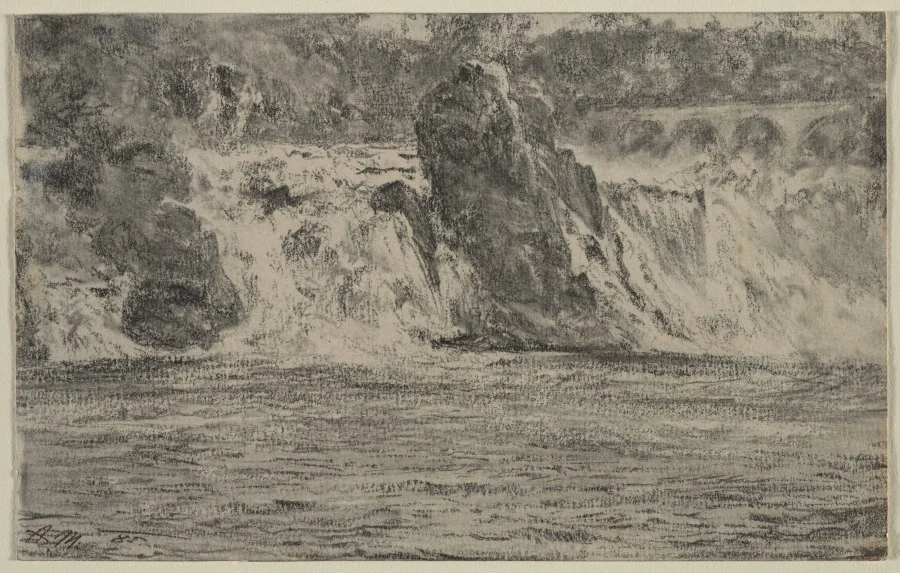
Menzel was one of the most celebrated and prolific painters in Germany during the 19th century. A meticulous draftsman, he executed detailed drawings in preparation for each of his paintings. Thousands of the artist’s notebook studies have survived. Many of them were studies of heads, half-figures, and landscape vignettes to be incorporated into his paintings. This sheet depicting a waterfall and bridge shrouded in mist is an example of one of Menzel’s exquisite graphite studies.
Provenance
Adolf Glüenstein, Hamburg; Adolf Glüenstein, Hamburg (Lugt 123, verso, lower center, in blue ink). [C.G. Boerner, Düsseldorf]
Accession Number
1985.147
Medium
graphite, with stumping (traces of white paint, along left edge, unrelated to composition)
Dimensions
Sheet: 12.3 x 19.5 cm (4 13/16 x 7 11/16 in.)
Classification
Drawing
Credit Line
Andrew R. and Martha Holden Jennings Fund
Tags
Drawing Impressionist & Modern (1851–1900) Graphite & Pencil German Color: Brown
Background & Context
Background Story
Adolph von Menzel's "Falls of the Rhine at Schaffhausen" is a masterful graphite study that captures the immense power and atmospheric drama of Europe's largest waterfall. Executed in 1885 using graphite with stumping — a technique of smudging the pencil marks to create soft tonal gradations — the drawing depicts the Rhine Falls shrouded in mist, with a bridge visible through the spray, reducing one of nature's most spectacular forces to an intimate, almost whispered notation.
Menzel (1815–1905) was the most celebrated and prolific German artist of the nineteenth century, producing paintings, drawings, and prints with astonishing range and technical command. His paintings of Prussian court life — particularly his depictions of Frederick the Great — defined the German historical imagination, while his drawings captured the energy of modern industrial life with unprecedented immediacy.
What makes this graphite study remarkable is its economy. Menzel was a compulsive draftsman who filled thousands of sketchbook pages with observations of everything from royal processions to factory interiors. In this sheet, he uses graphite's inherent qualities — its capacity for both razor-sharp lines and soft, atmospheric smudges — to convey the sensory experience of standing before the Rhine Falls. The stumping technique, which Menzel employed with particular mastery, allows him to suggest the spray, mist, and reflected light of the falls with minimal marks, leaving much to the viewer's imagination.
The drawing exemplifies Menzel's belief that the purpose of a study was not merely to record visual information but to capture the feeling of a place. His rendering of the falls avoids the grandiose spectacle typical of Romantic waterfall paintings. Instead, the falls emerge from and dissolve back into the paper's white surface, creating an effect of atmospheric immersion that feels startlingly modern. Menzel's influence on German art was immense — he paved the way for both German Realism and, indirectly, for the Expressionist generation that followed.
Cultural Impact
Menzel's thousands of surviving drawings constitute one of the most comprehensive visual records of nineteenth-century life ever created by a single artist. His meticulous draftsmanship influenced generations of German artists and established drawing as a vehicle for serious artistic expression rather than mere preparation.
Why It Matters
This graphite study demonstrates Menzel's genius for capturing the essence of a subject with minimal means — transforming the thundering Rhine Falls into a study of light, atmosphere, and the expressive potential of the humblest drawing material.